 Boyd Thompson's
32nd Bomb Squadron, 1942 -1945, Web-Site
Boyd Thompson'sII. Ditching in the Adriatic, by Joe Mangano
III. Disaster at 18,000 Feet, by Lt. Keith Taylor
IV. Last Mission in B-17 Aircraft Number 23380, from Frank C. McGinley's Journal
V. Amazin' Maizie Hits the News, sent in by William R. "Speedy" Wadlington
VI. Forced Landing in Russian Territory: "Sugar Report," from S/Sgt. Robert Richards' Journal
VII. 52 Days -- If You're Lucky: Sgt. Robert E. Richards Had Delayed Return to Base
VIII. The Personal Diary of James Franklin Boston
X. Art Unruh First and Last Missions
XI. 1st Lt. Robert Schwantes combat story as told to his Grandson
XII. Survivor Tells Harrowing Tale of B-17 "Laura" Crash
XIII. William Brainard's return to St. Jakob im Walde Austria after sixty-five years.
XIV. Rommel's Defeat in North Africa
XV. Commanding Officer Donald W. Ewing and Crew Parachute to safety from De De , Plane Number 29-7705
ON THE MISSION
OF 14 MARCH 1945,
the Fifteenth Air Force dispatched 848 bombers against targets in
Austria, Hungary and Yugoslavia. The 301st and 97th Bomb Groups used
visual aiming to drop 193 tons of bombs on the marshaling yards in
Komaron, Hungary, 20 miles from German lines. The 32nd Bomb Squadron
was assigned this mission and I was the tail gunner on "Miss BeHaven"
plane number 44-6407. 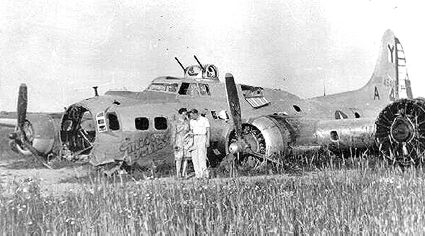 Early that morning, after a light breakfast
and briefing we departed Italy on our bombing mission to Komaron
Hungary. We encountered heavy flak before reaching the target and were
forced to drop our bombs prematurely due to our loss of power. With one
engine out and two others with reduced power we were forced to attempt
reaching Russian held territory in Poland. Keeping altitude was our
immediate concern in reaching the front lines between the German and
Russian ground forces. Somewhere near Myslenice south of Cracow our
situation became serious and at an altitude of approximately 1500 feet
Lieutenant Walter Podasek, the pilot put our plane on auto pilot and we
bailed out. Due to ground fire, believed to be from the Russians, we
were forced to ocillate in our chutes to avoid ground fire. Luckily, no
one was hit, however the ocillating made the landings difficult. Knees
were dislocated and some landings were in trees, steeples and rooftops.
Russian forces believing we were paratroopers captured and jailed us
even though I had an 18 inch square American flag with me and called
out that we were "Amerikanza." Jailing lasted a couple of days however
our Pilot, Lieutenant Walter Podasek spoke Polish and helped to arrange
our release. We were then on our own, using bicycles, truck or on foot
to Odessa Russia. Odessa was a collection point for downed Air
Personnel. We arrived back at the 32nd Squadron's base in Lucera, north
of Foggia Italy by ocean freighter via the straits of Bosphorus, Crete
to fly another day. It was the crew's belief that Miss BeHaven had been
destroyed in the crash. Fifty two years later in 1997 information was
received from Michal Mucha and Szymon Serwatka of Poland that our plane
had continued to fly crewless for 300 kilometers. It had belly-landed
in a field in a manner a real pilot could not have handled better. The
landing location was between Krotoszyn and Ostrow south east of Poznan.
(Michal and Szymon are conducting a WWII Aircraft MIA project in
Poland) Their Home Page Internet address is
http://www.samoloty.ip.pl/amiap/
Early that morning, after a light breakfast
and briefing we departed Italy on our bombing mission to Komaron
Hungary. We encountered heavy flak before reaching the target and were
forced to drop our bombs prematurely due to our loss of power. With one
engine out and two others with reduced power we were forced to attempt
reaching Russian held territory in Poland. Keeping altitude was our
immediate concern in reaching the front lines between the German and
Russian ground forces. Somewhere near Myslenice south of Cracow our
situation became serious and at an altitude of approximately 1500 feet
Lieutenant Walter Podasek, the pilot put our plane on auto pilot and we
bailed out. Due to ground fire, believed to be from the Russians, we
were forced to ocillate in our chutes to avoid ground fire. Luckily, no
one was hit, however the ocillating made the landings difficult. Knees
were dislocated and some landings were in trees, steeples and rooftops.
Russian forces believing we were paratroopers captured and jailed us
even though I had an 18 inch square American flag with me and called
out that we were "Amerikanza." Jailing lasted a couple of days however
our Pilot, Lieutenant Walter Podasek spoke Polish and helped to arrange
our release. We were then on our own, using bicycles, truck or on foot
to Odessa Russia. Odessa was a collection point for downed Air
Personnel. We arrived back at the 32nd Squadron's base in Lucera, north
of Foggia Italy by ocean freighter via the straits of Bosphorus, Crete
to fly another day. It was the crew's belief that Miss BeHaven had been
destroyed in the crash. Fifty two years later in 1997 information was
received from Michal Mucha and Szymon Serwatka of Poland that our plane
had continued to fly crewless for 300 kilometers. It had belly-landed
in a field in a manner a real pilot could not have handled better. The
landing location was between Krotoszyn and Ostrow south east of Poznan.
(Michal and Szymon are conducting a WWII Aircraft MIA project in
Poland) Their Home Page Internet address is
http://www.samoloty.ip.pl/amiap/
THE PHOTOGRAPH ABOVE is of our belly-landed Miss BeHaven, taken in the summer of 1945 at the landing location. You can see the aircraft was being cannibalised by the locals at that time. The damage from the landing and flak is visible. Also note the pilot had feathered two propellers prior to their bail out.
 ON
THE 20TH OF APRIL,
1945, the Fifteenth dispatched 783 bombers, including a formation of
132 B-17s that dropped 388 tons on the Vipetino Marshaling Yard. The
301st and 2nd Groups put 91 percent of their bombs within 1,000 feet of
the aiming point. Eight B-17s were listed as missing, including two
from the 32nd. The unit encountered very accurate flak that hit 1st Lt.
Howard Bower's aircraft, number 44-6737, in the number 4 engine just
prior to bomb release. The crew bailed out and became prisoners.
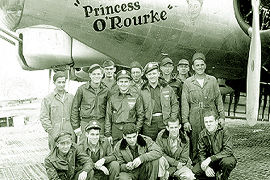
Meanwhile, 1st Lt. Robert Adams, flying the "Princess O'Rourke," number
44-6347, of the 32nd, fell back from the formation after the target.
Apparently hit by flak, Adams flew towards France, but was intercepted
by Swiss aircraft and was instructed to land. "Princess O'Rourke"
became the only bomber of the 32nd Squadron and the 301st Group to be
interned during the war.
ON
THE 20TH OF APRIL,
1945, the Fifteenth dispatched 783 bombers, including a formation of
132 B-17s that dropped 388 tons on the Vipetino Marshaling Yard. The
301st and 2nd Groups put 91 percent of their bombs within 1,000 feet of
the aiming point. Eight B-17s were listed as missing, including two
from the 32nd. The unit encountered very accurate flak that hit 1st Lt.
Howard Bower's aircraft, number 44-6737, in the number 4 engine just
prior to bomb release. The crew bailed out and became prisoners.
Meanwhile, 1st Lt. Robert Adams, flying the "Princess O'Rourke," number
44-6347, of the 32nd, fell back from the formation after the target.
Apparently hit by flak, Adams flew towards France, but was intercepted
by Swiss aircraft and was instructed to land. "Princess O'Rourke"
became the only bomber of the 32nd Squadron and the 301st Group to be
interned during the war.
SGT. HAROLD B. WHITBECK, a crew member on both of the missions, describes his recollections of the events narrated above: "Following our bailout of 44-6407 over Poland and capture by the Russians a few weeks earlier, with our regular crew piloted by Lt. Podasek, we were returned to our base at Lucera, Italy, just north of Foggia. Preceding the mission to Vipetino we had a "milk run," where we bombed the "front lines" in Northern Italy. We fired our guns at ground level at anything that moved. On our second mission after our bailout, we were scheduled to bomb the Vipetini Italy Marshaling Yards in the Brenner Pass. Stories were told that the ground gunners could fire downhill at you from the mountain sides. We left with the full compliment of enlisted men, but with a different officer crew. Our ship was piloted by 1st Lt. Robert Adams, whom we did not know previously and from whom we've never heard since. The enlisted crew consisted of Gus Burnham, right waist gunner, Fred Rasmussen, left waist gunner and radio, Vince Gamel, nose gunner and Joe Orman, ball turret. At the target we were hit by heavy flak, verifying stories of accurate fire from the ground and the mountainsides. We lost one engine on the right side of the "Princess," plus loosing power on a left-side engine. After dropping our bombs we lagged behind, and unable to stay with the formation, the Pilot radioed the Command and we headed for France. We were then intercepted by Swiss fighters and forced to land at Dubendorf, where we took out two or three fences before we stopped. We were photographed, fingerprinted, interrogated and taken to Adelboden and the "Nevada Palace." Our treatment was fair, allowing us freedom during the daylight hours, but off the streets at dark. We were not required to be at the hotel at night. Their food was generally less than desired, bland and often cold. Regimentation was lacking, but generally Swiss treatment was good. This was the last mission flown by the 32nd against an enemy in World War II. The war ended three weeks later, May 8, 1945, and I returned with the crew to the United States for further assignment."
SGT. JOE MANGANO was a ball-turret gunner on this mission and recalls the following:
SHORTLY AFTER turning on the bomb run, Me I09's shot out the number-four engine of our bomber, number 44-1398. Our pilot, Lieutenant Douglas Moore, had trouble feathering one of the two props after the number-three engine failed. We continued on the bomb run and released our bombs. While losing altitude, Lieutenant Moore ordered us to jettison all unnecessary equipment. I had gotten out of the ball turret by this time, and we tried to dump the ball turret and even shot the mountings with our .45-caliber pistols, to no avail. In all the excitement we threw out several parachutes. This meant our only option was to ditch in the Adriatic Sea. By this time we were at about 500 feet, and our pilot was able to regain level flight. The full power of the port engine was enough to just exceed stalling speed. At about 5 miles from the coast the number two engine blew up, forcing us to ditch off Pascara. I found out later that we had claimed two German Air Force fighters destroyed.
IT WAS A ROUGH DITCHING, and we had to swim like the devil to reach the rafts. Luckily, they hadn't been hit by enemy fire from the Me I09's, and I believe that saved us. We were picked up that night by the United States Navy and finally made our way back to our base in Lucera, Italy. I was scared to death, and truly think that we survived because we were all so young. I finally finished my fifty missions and was on my way back to the States when D day started. I sincerely believe that the man upstairs was looking after us that day. The members of our crew were Moore (P), Hunter (CP), Garrity (N), Upton (B), Flasiznstein (E), Frascatorf (RO), Gatrost (WG), Fish (WG), MacDonald (TG) and Mangano (LT).
WE WERE ABOUT TWENTY MINUTES from the target when our plane made a severe movement up and down, and then sideways, before returning to its place in the formation. The whole plane shook and vibrated with a loud noise like an explosion. Our Pilot was Captain William Wofford, and between the two of us we were sure this was the end. Everything that was loose in the cockpit was all over the place. It threw the bombardier up against the Plexiglas nose, knocking his oxygen mask off and then flipping him on his back. We continued on and bombed the target with reported excellent results. After we left the target area, about thirty Luftwaffe planes swarmed all over our formation. Our plane suffered some minor damage from flak and we lived to fly another day. I'm sure there was someone looking after us. The 32nd lost aircraft number 42-30466 on this mission and the fate of the crew was unknown.
THE OFFICIAL REPORT reveals the cause of the severe disturbance during the approach: Two 97th Bomb Group B-17s had engine trouble and began to leave the formation. Instead of making a 180-degree right turn, away from the formation, they turned to the left and flew head-on into the 301st formation. One flew below the leader's left wing and the other above and to the right, clipping the vertical stabilizer of Colonel Barthelmess's aircraft, and apparently hitting another 301st bomber before colliding with the lead bomber of the second element. One fortress in the lead element exploded, as did two B-17s in the second element. The P-38 pilots, who were flying low cover (beneath the overcast) for the mission, said they watched B-17 pieces raining from the sky for what seemed like five minutes.
THE COMMANDER'S and two other aircraft went over on their backs, not an ideal position for a fully loaded, iced up B-17. Two of those aircraft recovered at 10,000 feet. Others were not so lucky; the 301st lost five B-17s and their crews on this fateful mission. A navigator from the 419th bailed out and became a prisoner. One of the strangest stories of the war came from this mass accident. The collision severed the tail from one of the 353rd Squadron's bombers, trapping the crew in their positions. However, luck was with the tail gunner, James Raley, as the accident had left the tail section with adequate lift and weight distribution to allow it to fall or "flutter" to earth. Raley described the tail spinning around before finally impacting in a clump of pine trees. He was on his thirteenth mission, and did not realize what had happened until the tail came to rest. He opened the bulkhead door to find no aircraft. Raley was the only survivor. There was also a collision that downed a 99th Bomb Group bomber and a P-38 within 40 miles of the Group's disaster. (This "Official Report" information is from "Who Fears", the history of the 301st Veterans Association).
AND SO, UP INTO THE WILD BLUE YONDER, and the big day, little did I know, was started! Everything went smoothly with the exception of the supercharger on the No.1 engine, but we figured with three other engines, we would have no trouble whatsoever getting there. I was having a final cigarette and singing "Oh, what a beautiful morning, Oh, what a beautiful day", prior to putting on my oxygen mask, when I noticed that my chute had popped open. I never gave a thought then to any serious developments on account of this, but I remember thinking what a ribbing I would take from the boys at the base when they heard about it. However, soon after I made this interesting discovery, the Navigator informed us that we were approaching our IP and my thoughts quickly turned to the more serious business ahead. We were flying in "Purple Heart Corner" so we had a pretty good view of the boys ahead going through the flak, or I should say, disappearing in the flak. The whole sky ahead was black, just as it was the last time we were up there. It seemed funny to see and yet satisfying, too, watching what appeared to be toy airplanes in a cloudless sky plunge headlong into that black mass, disappear for a time, and then to reappear on their "rally". It seemed to radiate confidence back to us exhibiting a modest pride in a good job well done.
ALMOST SIMULTANEOUS WITH REACHING THE IP 'tracking flak' picked us up and began working its way toward us. Pilot Charles Mason had asked me at briefing earlier in the day to grab a couple of snapshots of anything worthwhile and with a start I remembered this and grabbed the camera. At almost the same moment, we spotted enemy fighters maneuvering into position, and hardly had I begun my call to the crew, when the Tail Gunner reported fighters attacking from 6 o'clock low and almost immediately he and the Ball turret opened fire, and the pounding of their guns sounded way up in the cockpit even over the roar of our engines, giving as good as was sent, as evidenced by the exultant crow of victory as one of the fighters began smoking and started haphazardly spiraling down, out of the fight for keeps. Finishing their pass at the tail as is the custom of the Foche-Wolfe 190's, they channeled to the right, peeling down to make another pass and exposing only their heavily armored belly to the waist gunner in passing. His tracers were cutting a path to one of these fighters, so I lined him up in the camera sights all set to snap what would have been a swell shot, but at that instant, the ship on our right wing received a direct flak burst and almost immediately burst into flames and started down. I guess none of them ever knew what hit them, and I took the camera down and watched them for a moment with a sinking feeling in the pit of my stomach as I realized they were gone. I knew them all and now they were gone with nothing to mark the spot except a trail of oily smoke! I was jarred out of these thoughts, but definitely, when a flak shell burst below our right wing, throwing the ship violently upwards. The main point of damage was in the wing, directly behind No. 3 engine; as though some giant hand had torn a jagged section from the wing, and not satisfied with that, had furthered the destructive work by setting fire to it as well. No. 3 engine was completely knocked out and I remember thinking what a job we would have getting home with all the damage, while with half of my mind I realized it was only a question of time before the ship would blow up. I kept watching the fire, attempting to figure out how long we would last. Could we reach our target to drop our bombs, and would we be able to clear the target before we had to leave her?
DURING THESE MOMENTS WHILE MY THOUGHTS WERE RACING ALL OVER THE PLACE, all hell was breaking loose in the surrounding skies, and I found I was still automatically carrying out my job, setting the prop speed higher, giving our remaining engines all the juice they could take. Four fighters were still coming in, so I grabbed the camera and got a sweet shot as I had planned before, a Foche-Wolfe peeling away and down followed by the tracers from the Waist Gunner, only in the foreground I had focused on our own burning wing. I got one other shot of three Foche-Wolfe coming in from 4 o'clock high, when the Pilot called my attention from the business of calling out the fighters and taking pictures of the same. Our intercom phone had been shot out, so by gestures he informed me that these continued fighter attacks had destroyed our elevator controls and it took our combined strength to hold the ship straight and level for the bomb run. It was now more than ever a race with death to see if we could hang on until our bombs were away and we had gotten clear of the burning target areas before we bailed out.
THE FIGHTERS WERE CHANGING THEIR TACTICS NOW, varying their attack front and rear. The Tail Gunner was killed on one fighter pass and the quiet that settled over the ship told its own tragic story. Our Ball Turret Gunner had also gone to "Airman's Heaven", apparently killed instantly by the flak burst that so damaged our wing. Another flak burst, quite close, destroyed what was left of our aileron control and the A.F.C.E. mechanism too was not functioning. The cry of "Bombs Away" gave us mingled feelings of satisfaction, relief and regret. Relief that we had done our job well, but regret for at that clarion call, our last connection with our buddies was severed.
THE GROUP RALLIED ON THEIR WAY HOME, while we had no choice but to continue straight ahead, hoping to reach a safe place to bail out before the fire reached our gas tank. Almost as though a part of a pre-arranged plan, our exit cue was given by an off stage prompter in the personage of an unknown German fighter pilot. Our top turret gunner was very short in stature and to that fact alone, can he attribute his prolongation of life at that particular moment. One of his guns jammed, and being small, he had to duck down out of the turret to clear the jam. While thus engaged, a spray of lead perforated the cockpit, and a 20mm cannon shell burst in the turret, blowing it completely off the ship. It was almost laughable to see his eyes bulge out in surprise as he stuck his head out of what was left of his gun mount into the slipstream. Then, to add insult to injury, for the first time he noticed the wing burning; a tribute to his concentration on protecting the ship from the fighters. When he spotted the fire he crawled out of his turret again and forcibly called the pilots' attention to the fire. Up to that time I firmly believe the fire was known only to the Bombardier and myself. He had noticed it while following the erratic flight of an Me109 he had shot down.
THE ALARM BELL RANG and the top turret gunner started toward the bomb bay preparatory to leaving the ship. By the time I got my chute picked up (or, so I thought) he had already attempted to open the bomb bay doors, and failed. He jumped into the bomb bay just as I came though the door and partially sprang it, and by kicking and squirming he got out, almost.The door slammed shut on him, just as he fell out, catching his left arm and part of his chute inside. Don't ask me why, but I automatically used my old bean for a change and jumped into the bomb bay and sprung the Engineer clear. It is fortunate for him that I did, for he told us later that the slipstream was banging him against the fuselage and seemed to be tearing his arm out of the socket as well as ripping his shroud lines. However, he was out now and that's what was the important thing. It was then, however, that I started to sweat because when I went back to again try to open the bomb bay doors, through the door came good old Lt. Mason with the rest of my chute. I hadn't known till then how badly caught my pilot chute was in the turret and seats. He very nicely handed me my chute, signaled 'thumbs up', pulled the bomb bay release (this time it worked), and out I went, the chute ballooning right in the bomb bay. What a feeling of relief when I swung clear of the ship. I then looked up at my pretty little chute and started my sweating all over again, because two complete panels of the chute were torn out, either in all that jumping around the bomb bay, or when the chute opened in the ship. I said my favorite little prayer, although I didn't do too good a job of it at the time. As I looked, the chute made an ominous ripping sound just once, and after that is was the most pleasant, peaceful grandstand seat any man could ever have for a real view of combat at its best or worst, depending on your point of view.
I COULD SEE OUR SHIP, SMOKE AND FLAME STREAMING FROM IT, majestically descending and Mason's chute billowing behind it. I could spot other chutes below me, and see fighters still attacking old "Pistol Packin Mama". One of them buzzed me, but did nothing more than start my chute gently oscillating. Off in the distance I could see our boys going home silhouetted against a sky darkened by the rolling clouds of smoke and flame emanating from the target area.
DESPITE THE COLD I FELT PRETTY GOOD. Around 6 PM the sun disappeared over the hill and I prepared to shove off. Little did I know then that the twilight would be my undoing. My place of concealment was OK in the sunlight, but with the sun's rays no longer glancing off my leafy covering, I stood out like a sore thumb. Halfway down the hill, three German or Austrian soldiers were still searching when one of them looked my way, and that was that! He leveled his gun at me, shouting at the top of his lungs in what sounded like double-talk. As though by magic, forms seemed to spring up all around me; old men with Nazi arm bands, Youth Movement kids and even two young girls with guns bigger than they were. I don't know what worried me most, the thought of capture or those nervous kids with guns. They were a lot more nervous than I was however, I thought at any minute they would let go at me. It sounds funny now even to me, but believe me, at the time, I wondered! I rose to my feet and tried to explain to them I was 'waiting for a streetcar' and if they would go away they would make me very happy. They apparently didn't understand the language, and all I could get out of them was a light for my cigarette. They wouldn't come close to me. They just threw the matches at my feet. After looking me over like a "Man from Mars", they finally marched me off to a flak battery nearby where they tried to explain they had a comrade of mine. It didn't feel too near with my bare feet. As we approached, I recognized Sgt. Crockett, the good soldier he was, greeted me with a snappy salute which I returned. I was sorry to see he had been captured, but was glad to see him looking okay. I had been wondering how badly he was hurt when he was caught in the bomb bay. His left arm was pretty badly banged up, but I couldn't tell if it was broken or not! He wondered who it was that released him from the ship and was profuse with his thanks when I told him I was the lucky boy.
I THEN TRIED TO COMMUNICATE TO OUR GERMAN HOST that I wanted a Doctor to look after Crockett's arm and they ran off and returned in a moment with a cup of weak hot chocolate. Apparently they misunderstood me slightly. By reverting to sign language and a soft-shoe dance, I finally got it across to them that I didn't usually appear in public with only one shoe on! They took the hint and dug up a boot for my left foot and then, by motions and a gentle prodding with the muzzle of their rifles, we got the idea that another tour of Austria was to begin. We walked, limped or what have you, lugging our chutes with us through the hills and vales and little villages for what seemed an eternity. At each village or farm settlement, we picked up a following of civilians, all anxious to see the vaunted American Terrorfliegers. Although I couldn't understand what they said, I gathered that they didn't exactly like us nor our bombs. C'est La Guerre! Knowing as we did that some of our boys had met with rough handling at the hands of irate citizens whose homes had been destroyed, this little gathering didn't make us feel any too good about the whole situation. We finally arrived at our destination, the headquarters of the flak batteries stationed in that area. Here we met another American Sergeant with a badly wounded leg. He was waiting patiently for assistance, but there didn't seem to be much being done about it. One of the Jerrys understood English slightly, and through him I made my demands for medical attention for these two injured men. They got a medic for them, and I was then taken into the inner sanctum to be interrogated by a Major who was their Commanding Officer.
IT WAS HERE I FIRST MET LT. DICK EGGERS. The four of us were finally moved out to the airfield in the town of Wiener Neustadt for safe keeping. We were put in the back of an open truck accompanied by soldiers with machine guns to guard us. They started the 'cold treatment' that I was to feel so much in the days to come. We weren't exactly dressed for the occasion and had only our parachutes for protection from the bitter cold wind. At one of the towns we picked up a flock of young Jerry soldiers, Luftwaffe ground crew, who were also heading for the airport. Again, we were subjected to the suspicious and curious scrutiny of German eyes. They soon turned from this unprofitable pleasure to skylarking. I imagine, for our benefit, like a bunch of good old G.I's with half a load on! Any passing person, male or female, was in for a chorus of catcalls and whistling. But every time we passed a demolished or semi-demolished building or area they quieted down and bestowed looks of hate in our direction. We finally arrived at the airfield, and before we were taken in we had the opportunity of seeing the German night defenses practicing their deadly work. A simulated attacking bomber was "coned" with their searchlights, and various night fighters made pass after pass at it. We thought it might be the real thing for a while, but the markings on all the planes became clear as they approached and we saw they all had the German Cross on them. The same German Cross that we had seen earlier that day going down in flames.
A FORETASTE OF WHAT WAS TO COME. A death-knell for a nation doomed to final and definite destruction. Maybe not in a day, nor a month, but coming inexorably closer with each passing day, each mission completed, with each battle won. We found out later that our thoughts would not always be this high, but deep inside we always knew and believed in the inevitability of Germany's end and with this rested our future hopes. We were finally taken inside what appeared to be a Luftwaffe guardhouse and the four of us were taken into a room about 20 feet by 7 feet. By sign language we were told to make ourselves comfortable, ha, ha! Eventually they brought in some live coals and started a fire in our little stove. Boy did that warmth feel good. Eggers understood a few, a very few, words in German, the most important of which at the time was 'essen' (to eat) and 'wasser' (water). They got the idea finally, and brought us coffee, a loaf of black bread and a piece of bacon. It was actually 90% fat. They kept pointing at the food, saying "Gut!, Gut!", indicating that this was a very special treat in Germany. That's what we needed to really warm us we thought, but when we tasted it, brother, all I can say is it shouldn't happen to a dog! If there is anything in this whole world that tastes worse than "Ersatz Coffee" it's "Ersatz Tea", and I hadn't encountered that as yet. Our German chums didn't like our refusing to drink their 'devils brew' and thought we were crazy when we expressed a desire for just plain "wasser". However, they brought us some and we attempted to satisfy the "inner man" with these choice morsels. As in our previous encounters with them, we were again the center of a curiosity bitten throng. After eating and warming up a little at the fire, we realized we had a pretty long eventful day, and a little sleep wouldn't hurt. We stretched out as best we could on our "Simmons mattress", boards to you and they took the hint, while putting out the lights as they left. Tired as I was, sleep didn't come easily, and midnight found me still just dozing and reviewing the day's happenings. Then I heard quite a commotion in the hall. I lay for a minute wondering 'now what'? Then above the noise I heard a familiar voice ask 'who's got a light?'. It was Dick Moon's voice, the last man I talked to outside of the crew before taking off. We had ridden out to the line on the same truck and as each group of men jumped off and went to their ships, the usual remarks were passed; "Good luck gang, see you at mess" or "Have a nice time, boys". That wasn't the way Dick saw it. As he jumped out he turned and laughingly said, "See you in Chetnik Headquarters, Mac". And now here we were 18 hours later, both Prisoners of War, and nary a chance of getting to Yugoslavia "Chetnik Headquarters". I waited a couple of minutes and then walked out into the hall and greeted the boys. I came out into the lighted hall, rubbing my eyes and growled, "Say, can't a guy get any sleep in this joint?!" Boy, did that give them a jolt! Talking it over later, I found out that they had been wondering what happened to me, and my sudden appearance had kind of a ghostly tinge to it. With Dick were the other boys from our ship; Mason, Rossi, Baker and our waist gunner Rauch, and also Dick's ball gunner and Engineer.
IT WAS PRACTICALLY A GATHERING OF THE CLAN. We were chased back into our 'boudoir' where we woke Crockett and the other boys and made the necessary introductions. The Germans brought in some bread and coffee for the new arrivals and we sat back to watch their reaction to Germany's contribution to the coffee industry. We got quite a laugh from the hurt look on their faces! The old bull was thrown, while they ate, about our varied experiences of that day and as the saying goes, "The first liar didn't have a chance". We finally retired once more to our not so soft bed and I wound up firmly wedged between Rossi and Dick. Came the dawn and I pried my way out of Rossi's embrace and woke him with a punch in the ribs. He woke up and seemed disappointed to find me there instead of who he was dreaming about. Finally all of the boys came out of it and we started jabbering where we left off the night before. About 8:00 AM our German chums brought in our morning taste thrill. We managed to polish it off and then one by one we were taken in and searched and questioned. Some of the Jerrys were sullen and grim, but some of them were just young happy go lucky kids. We found out later that the airport we were at was not only a fighter field, but an advanced training base for their pilots. This explained the hoards of kids around the place. It was funny to try and talk to them as they were pretty impressed by our "Bombers" and tried to demonstrate how they in their fighters would attack us. We tried to talk them out of the flying game, telling them that while they might knock a few of us down, we got our bombs on target regardless and most of us went home to fly again the next day and there were plenty more to take our place. Meanwhile they (the Jerrys) were getting fewer and fewer after each battle. For example, just the day before, their losses outnumbered ours, 3 to 1, despite the fact that they had thrown their best men, Goering's crack "Yellow Nose Squadron" against us. It was sort of a revival of an old feud. During the battle of Africa, our Squadron had tangled with Goering's boys and cleaned house.
AS A BADGE OF VICTORY, FROM THEN ON OUR WHEELS WERE PAINTED YELLOW, as a constant reminder to Jerry of that meeting. We sustained the heaviest losses of anyone the day before for this very reason. Our wheels stood out like sore thumbs and boy did they lay for us! However, we took a lot more of them down than they did us and by holding their attention, so to speak, we saved the other boys a lot of trouble. Even so, 3 out of the 4 ships of our Squadron that went down managed to fight them off until we dropped our bombs on the target. Not a bad record when we took the brunt of the attack. However we couldn't convince these kids that it was all over but the shouting, despite the fact that for the moment they were the victors and we the vanquished! Along about 10:00, a Jerry came in all excited about something and despite the cold opened our only window. We immediately set up a howl, but he kept hollering 'boom!' and shaking the windows, so we finally got the idea that someone's bombs hadn't gone off yesterday and they were going to set them off now and he wanted the window open so the concussion wouldn't break it. This was something new as we had dropped plenty but had never heard or felt them go off before. We were still talking when "Broooom!", went the first one. What a blast! The window slammed shut and the noise was deafening. This was repeated at intervals until all six were set off. Boy, what an experience! We knew they were being set off at a distance and individually, but it was still terrific. What must it be when hundreds or thousands of these babies go off almost at once. No wonder Jerry is on his way out. This turned the discussion to the effects of our bombing yesterday. We know from what we saw that we did a good job. But when one of the Jerrys slipped and told us that we had put 90% of the plant completely out of commission, we were as excited and pleased as schoolboys after a big meet. The questioning took up most of the day, and during the course, we discovered we weren't the only new captives. Dick Egger's Bombardier, Charlie Major, was in another room with some enlisted men from a B-24 crew. At about 7:00 we were told we were to be moved out that evening. At 8:30 all 20 of us piled out and got into the bus they had waiting. Moon and I went way to the back where there was an emergency exit that we thought might prove interesting. We had 4 or 5 Jerry guards armed with Tommy guns, but they all sat up front, so as soon as we got clear of the field, we went to work on the door. Unfortunately, it was double-barred on the outside and the windows too were locked. Before we had much success with the hinges on the door, we pulled into the railroad station, and that was that.
WE WERE HERDED INTO A WAITING RAILROAD CAR and were joined by 20 other boys who had been captured the day before and had been kept in storage at another point. The car was faintly reminiscent of our own streetcars at home with wooden seats and windows that naturally wouldn't open. Our supplement of guards was increased to about 20 and they brought along our food for the trip. It was more of the black bread and cheese. We felt the cold and the drafts from the broken floor boards of the car, so we huddled together as best we could with our feet on the opposite seat to get away from the drafts. But that didn't last long, as a Jerry came back and knocked my feet to the floor with his bayonet. I knew then how those comic tramps felt in the movies when the "Copper" banged their feet to keep them from sleeping on the park benches. We had quite an audience of civilians on hand, eager to view 'those Terrorfleighers' and we amused ourselves until the train pulled out by making horrible faces at them and growling like hungry animals. Finally the train pulled out and to keep our spirits up and also for Jerry's benefit, we started a songfest. "I Got a Gal in Kalamazoo", "The Air Corps Song", "I've Been Working on the Railroad", etc .The time passed quickly despite the cold and we soon found ourselves pulling into Vienna. It was a totally different Vienna from the one we knew in the movies. It was just another darkened, scared, war torn town. We pulled into a small station just on the outskirts of town and, picking up our allotted food ration, we staggered off the train. The word "staggered" is an exaggeration, of course, but I sure wish you could feel the weight of one of those loaves of bread. A man has to be in damn good shape to carry one of them, much less thrust it into his unsuspecting and unconditioned stomach! We had to walk about two blocks from the station to a trolley stop. The first car that came by was commandeered for our private use. I don't imagine the civilian population liked the idea of getting off, but you know how it is, nothing too good for the Americans and we couldn't associate with just anyone ha!, ha!. After about 15 minutes ride out we went again.
THIS TIME WE WERE IN THE CENTER OF TOWN and had another short walk through a fairly decent looking park and arrived at the main station. The inside of the station was brilliantly lit and it took a moment to accustom our eyes to the glare. My first impression was eye staring eyes all over the place! Everyone in the place stopped still for a minute and once again, we were the center of attraction. Our guards herded us off to a corner of the concourse and the silence was broken only by the angrily ominous mutterings of the bystanders interspersed with a few typical American wisecracks. We had about half and hour until train time and in that time we got quite a view of the cross section of the German people. Few and far between were smiling faces. For the most part, tears and bitterness were the predominant emotion. Soldier after soldier with full pack was taking leave of his loved ones while a few, a very few were coming home on leave. What caused us the most surprise was the age and in some cases, the lack of it in their fighting men. They were all very old or very young, the bottom of the barrel so to speak. Finally our train pulled in and we trotted off to embark again for points unknown. Our guards had little trouble clearing a path for us and even more trouble explaining to the other passengers that we must have seats together so they could keep an eagle eye on us. We got hold of a map from their timetable and were able to trace our course through Nuremburg, Lilz, Regensburg, etc. In all of them we could see evidence of where the 'stone termites' and been at work with good effective bombing where it was needed.
WE FINALLY PULLED INTO THE TOWN OF FRANKFURT. We looked hard all around us, but could see no evidence of any bombing. We found out we were going to Oberusel, a few miles out of town, where we would be interrogated. On our arrival there we had the alternative of waiting two hours in the cold for a bus or hiking about two miles to the "cooler" as our new home was affectionately to be known. Putting it to the wounded men in the party, we decided to do it on foot. When we got to the "cooler" we were all packed into a very small room and then called out individually and assigned to a private room for each man. Of course, at Sing-sing it is known as solitary confinement and 'that ain't good'. My room was 8 ft by 4 ft, with one barred window, a steel bed with an excelsior mattress encased in burlap. It had 8 boards to support my weight, two thin blankets to cover me, a chair, a water pitcher and a radiator. I found out later to my great discomfort that it didn't work. Despite the cold, I had to strip down while my clothing was searched. Everything of value was confiscated, my lucky silver dollar went, my pencils, notebook, cigarettes, candy, and they even took my prayer book. I had to talk like the devil to keep my Rosary. I spent a very restless night and as a result of my unsuccessful interrogation, I spent a very uncomfortable one. The next day was a repetition of the previous one. At 8 AM I had my two slices of bread and tea and at noon hot potato soup (it sure tasted good, then) and at 6 PM I got two more slices of bread and tea. I managed to fill up the days by counting the nails on the walls, the boards in the floor, etc. I exercised, prayed, and waited. It is hard to describe these days now as time crawled by. With the end of the interrogation phase of our journey, we were transported by train to our POW camp. We had arrived at our final destination, Stalag Luft 1, our new home for the duration of the war. (Ed. note: Stalag Luft 1 was liberated by Russian ground troops at the conclusion of the war in Europe.)
AFTER MORNING FORMATION we were allowed to look over the extent of the camp open to us. We wandered around a while but the Chapel and Theatre were locked up and a light drizzle finally drove us back inside. We finally got around to introducing ourselves to our roomates-mostly Canadians and darn good boys they turned our to be. Pappy Bryan, Bill Coleman, Larry Aspinall, Harry Meyer, "Old timer" MacCullough and another one our our boys from Africa, John Cashore. We spent the rest of the day telling and retelling our terror stores, etc. The only break came when a little Englishman popped in to bid us a very hearty welcome. He had a RAF uniform on with no rank showing and he talked so fast we couldn't make head nor tail out of it, except the word "Padre". When he left we compared notes but it wasn't until later that day that we found our that he was Father Hall who was to be the best friend we had in camp and the hardest working man I ever met. He was captured in Rotterdam in 1940 as a civilian internee and had volunteered to come up here as our Catholic Chaplain. We had an organizational meeting that evening and got the ball rolling as far as camp activities went. Sports representatives, cooking, clothing, coal supply, rationing etc. etc. were all appointed and with a feeling of contentment that things were under way we turned in. Of course, the fact that all the lights were extinguised at 10 PM may have had something to do with our new 'early to bed-early to rise' routine.
(Ed. note: The diary ends here. Surely there was more, but that information unfortunately is lost. Stalag Luft I, Barth, Germany, Barracks # 3, Room # 10: Frank C. McGinley, L.R. Moon, R. J. Eichenlaub, M.S. Baker, H.N. Mullaney, J. E. Peacock, D. G. Naughton, A. O. Williams, R. C. Howard, E. R. Chesmore, R. F. Eggers, B. J. Fuller, K. D. Haines, A. N. Rossi, W. C. Coleman, C. E. Mason, R. S. Macauley, D. A. Reagan, Ed Fennessey, W. C. Thompson and J. A. Graham occupied Room 10 in Barracks 3.)
ONE OF THE POEMS written by Frank McGinley
while a prisoner in Stalag 1. It was sung by the prisoners in Room 10,
Barracks number 3. to the tune of Bob Hope's theme song, "Thanks for
the Memories."
Thanks for the memories, of
flights to Germany
Across the Northern Sea, with blazing guns
We fought the Hun, for air supremacy.
How lucky we were!
Thanks for the memories, of
Me-109's
And Flak guns on the Rhine
They did their bit and we were hit
So ended our good times...we miss them so much!
We drifted far out of
formation
We jumped-and what a sensation
And now we sweat out the duration
Our job is done, we had our fun.
So thanks for the memory
Of days we had to stay, at Stalag Luft 1A
The cabbage raw which had to do
Till Red Cross Parcels came
How thankful we were.
So thanks for the memory
When "D" Day came along
We changed our marching song
From "Forever and a Day" to "War ain't Here to Stay"
We thank God for that!
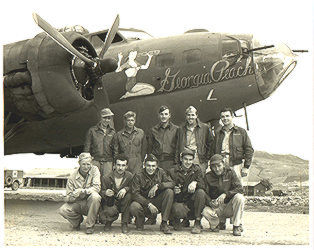
For more information contact
Chuck McGinley, 6913 SW 167th
Place, Beaverton, OR 97007. Telephone:
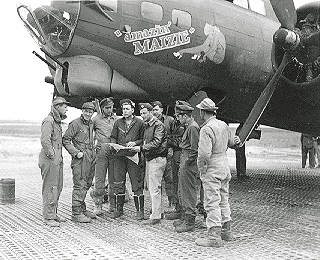
15th Air Force in ITALY--The amazing maintenance record of "Amazin' Maizie," a Flying Fortress crewed by T-Sgt, William R. "Speedy" Wadlington (left), 28, of Sledge, Mississippi, is a tale of changing wings like most people change socks.
 THE
GIANT FORT, named for Maizie Ann Harding of 488 E. 14th
St., Tulsa, Oklahoma, wife of the pilot, Major Edwin F. Harding Jr.,
was put in Bill's charge when it was brand new early last February. He
didn't have any trouble until the third mission, when "Maizie" got shot
up over Reginsburg, Germany, and was one of the two ships that got back
out of the Squadron. Then was when the first wing had to be changed,
along with four engines, propellers, chin turret, landing flaps and a
complete tail.
THE
GIANT FORT, named for Maizie Ann Harding of 488 E. 14th
St., Tulsa, Oklahoma, wife of the pilot, Major Edwin F. Harding Jr.,
was put in Bill's charge when it was brand new early last February. He
didn't have any trouble until the third mission, when "Maizie" got shot
up over Reginsburg, Germany, and was one of the two ships that got back
out of the Squadron. Then was when the first wing had to be changed,
along with four engines, propellers, chin turret, landing flaps and a
complete tail.
THREE MISSIONS LATER flak caught the main spar in the right wing, necessitating a replacement. After two days out because of that, "Amazin' Maizie" flew again and came back with the wings riddled--and so a new set was put on by "Speedy" and his crew.
A STREAK OF GOOD luck prevailed for a month, as his ship made every mission with no trouble. But that wouldn't last and on the return from the next mission there were gaping holes in the wing gas tanks--and so for the fourth time the wings were dropped.
"SPEEDY" AND HIS crew were getting to be experts when again several missions later--yes--another wing change. On the 55th mission all four engines were hit and the left wing for the sixth time had to be replaced.
COMMENTED WADLINGTON, "After that we only had minor troubles such as replacing tail assemblies, hydraulic and oil systems--nothing difficult!!"
IN 68 CONSECUTIVE MISSIONS without a turn back due to mechanical failure "Amazin' Maizie" led the Air Force three times and at one time led the Squadron for a month straight, all of which Bill modestly attributes to "a good crew and luck."
NOW THERE IS an "Amazin' Maizie II!!"
YES, IT WAS DECEMBER 26, 1944, and we were lucky enough to hit the battle order. Our 32nd Bomb Squadron is having a Christmas party in Foggia. It was quite a party although I didn't attend. We got up bright and early for briefing only to find that once again we were going to that well-known target of Blechammer Germany. It was a well-known target for its oil and half of the flak guns the Germans had. But we didn't mind, for we had been there three times before.
AS WE STARTED on the bomb run the flak began to hit us all over and it sounded like all hell had broke loose. In fact it did. No one had any closer calls than the other. We got a bad hit in the number one engine and it started a little fire and as we feathered the engine it put the fire out. The Lord was with us all the way for all of us came out without a scratch.
WE THOUGHT we would have to bail out but we were stuck with the ship. Number three and four engines were almost shaking the ship apart but we hung on. After we had traveled about a hundred and fifty miles a field was spotted and we decided to make a landing there. At least seven or eight Russian Fighter planes came up to get us but due to the luck, they recognized that we were not Germans. They started to make a couple of passes but broke away before firing.
AT LAST we were going to land and everyone was sweating out what kind of landing we were going to make. No one actually knew just what damage the ship was in, but Kage and Bill brought her in and made a most beautiful landing. At least it seemed good to know that our feet were on solid ground. It was a feeling that was just out of this world. The time in between bombs away and landing will never be forgotten for I'm sure that it was at least two or three years of my life.
WE WERE GOING to get out of the plane as soon as we landed but it seems as though the civilian population was all congregated around the plane. We stayed in until a Russian Lieutenant and two guards with fixed bayonets came marching through the crowd. As soon as we saw them we crawled out of the plane and all ten of us stood together.
THE RUSSIANS GAVE US a quick "high ball" and the first thing they asked was whether we spoke German. Of course no one knew what they were saying but we shook our heads no. They finally took us to a little village and fixed us up with a fancy meal of raw bacon and other fat meats and above all a nice shot of vodka. It was then that we found out that we were only about 2� miles from the front. I thought that the artillery guns sounded awful close. We also could hear small arms fire that was too close for comfort.
WE STAYED with the Lt. Colonel that was in charge of the infantry around there. He was a swell Joe and we had a good time with him although we only stayed with him for two days. They then got the bright idea that being we were Airmen we ought to be with the Air Corps. They moved us and then the real things began to happen.
THAT NIGHT they gave a dance for us and we were the only ones that were allowed to dance with the girls. But being we didn't know much about Russian style of dancing we just let the men take over. We were all getting tired so we went back to the sack to get another night of beauty rest on our board beds.
THE DANCE ended early so we went back and hit the sack. What a sack it was because my back is still aching.
EDITOR'S NOTE: It is with pride that I share my brother's journal of their forced landing experience in Russian territory. From the news reports it took the crew 52 days to return to their 32nd Squadron stationed in Italy. Robert completed his 25 bombing missions and returned to the United States. He raised a family and had a successful business. He passed away in November of 1973 at the young age of 50.
FOR MORE INFORMATION, contact Charles J. Richards, 2421 Williams Drive, Quincy, MI 49082-9644. Telephone 517-639-7192, e-mail cjrichards@charter.net
15th AAF IN ITALY-- Blechhammer, Germany is only about four hours away from southern Italy by heavy-bomber, but S/Sgt Robert E. Richards, R.R. 1, Grabill, Ind., tail gunner on a 15th Flying Fortress, found out the hard way that it can take 52 days to get back --if you're lucky!
 ON
THE DAY AFTER CHRISTMAS during an attack against the oil
refineries at Blechhammer, Richard's Fort was ringed with flak from the
multitude of ack-ack guns protecting that vital target area. Several
near misses stabbed the ship with flying steel, and disabled the oxygen
system, the hydraulic system and all the instruments, including both
compasses, which left the crew isolated in space.
ON
THE DAY AFTER CHRISTMAS during an attack against the oil
refineries at Blechhammer, Richard's Fort was ringed with flak from the
multitude of ack-ack guns protecting that vital target area. Several
near misses stabbed the ship with flying steel, and disabled the oxygen
system, the hydraulic system and all the instruments, including both
compasses, which left the crew isolated in space.
THE NAVIGATOR'S COMPUTER was shot from his hand, and the radio operator lost his transmitter key in the same abrupt fashion; the emergency rations were peppered, most of the parachutes were shredded beyond utility and the gas tanks were riddled. One burst put the bomb racks out of commission and for the next few hours, while Richards was splicing severed control cables, the bombardier balanced on the narrow catwalk kicking out bombs to lighten the load.
AFTER A PERIOD of welcome recuperation at this stop, Richards and his crew were taken to an evacuation headquarters for Allied airmen. Here they were picked up and flown back to their base in Southern Italy.
"It was the rough way home all right" commented Richards, "but we were lucky to land in Russian hands. They made sure we had the best of everything they could give us!"
HE COMPLETED telegraph and telephone school at Camp Crowder, Mo., on July 17, 1943 and won his wings at Las Vegas, Nev., on May 6, 1944. After leaving the United States on August 8, 1944 he flew his first mission, an attack against Barovincia, Yugoslavia on August 26.
HIS WIFE, Mrs. Glada Marie Richards and their two children, Allen, 2, and Nadine Fay, a recent arrival, reside at the above address while his parents, Mr. and Mrs. Charles W. Richards, reside at R.R. 1, Fort Wayne.
James Franklin
Boston-14094612
U.S. ARMY AIR FORCE
Religion: Protestant
Date of Birth: August 26, 1921
Color of hair: Blonde
Height: 6 feet 3 � inches
Color of eyes: Blue
Nearest relative: Mrs. J. I. Boston, Mother, Curryville, Georgia
SERVICE RECORD
Transfers and changes in rank:
Enlisted as private on
Friday, March 13, 1942 in old P.O.
Building in Atlanta Georgia.
Appointed Aviation Cadet, May 12, 1942.
Arrived at Napier Field, Dothan, Alabama, May 26, 1942.
Arrived at Gunter Field, Alabama, June 2, 1942.
Arrived at Maxwell Field, Alabama, June 12, 1942.
Arrived at Turner Field, Advanced Navigation School, Albany, Georgia,
August 16, 1942.
Arrived at Advanced Navigation School, Monroe, Louisiana, September 18,
1942.
CLASS OF 42-16, FLIGHT 56.
Set back to Flight 26, Class 43-1 November 6, 1942.
Graduated as 2nd Lieutenant, Selman Field, Louisiana, January 16, 1943.
Arrived at Salt lake Army Air Base, Utah January 20, 1943.
Arrived at Blythe Army Air Base, California, January 24, 1943.
Arrived at Pyote Army Air Base, Texas, February 3, 1943.
Arrived at Casper Army Air Base, Wyoming, March 8, 1943.
Arrived at Salina, Kansas (6-day delay en-route) April 17, 1943.
Arrived at Morrison Field, West Palm Beach, Florida May 2, 1943.
Arrived at Warner Robbins Field, Macon, Georgia May 7, 1943 for
installation of “Tokyo Tanks.”
Arrived at Morrison Field, Florida, May 15, 1943 for the beginning of
foreign service.
May 17, 1943-Departed from Morrison Field, West Palm Beach, Florida at 02:00 with clearance to Waller Field, Trinidad. Passed by Nassau on course, possible to do pilotage occasionally on small islands. Were ordered to be on lookout for the crew of a B-25 down in water. Passed 30 miles right of position reported. No survivors were seen. Landed at Boringuen Field, Puerto Rico 10:30, because of strong headwinds, very stormy and turbulent weather, No. 1 engine throwing oil, interphone out, and no radio contact. Boringuen is one of the nicest fields I have ever seen.
May 18, 1943-Departed Boringuen at 11:00 for Waller Field. Flew along about 60 miles west of Martineque and Guadaloupe. Rounded Galeria Point and landed 17:45 at Waller Field, Trinidad. On way to Trinidad saw a phenomenon reported only a few times previously—a small circular rainbow on the clouds below us with the silhouette of our plane in the center. Very Beautiful.
May 20, 1943-Took off Waller Field at 1:00 local time for Belem, Brazil. Arrived at Belem 07:30 later. Met A. Boraiko (42-16) now in ferry command and has made one trip to India. Now on second trip across. Said Ralph Adams is briefing Officer in Khartoum, Anglo-Egyptian Sudan. Some other classmates at Accra and Roberts Field. Belem is worse than Waller. Water and food bad, except for fruit. Plenty of mosquitoes.
May 21, 1943-Took off for Natal, Brazil 06:00 local time and landed Paranarim Air Base 12:30.
May 23, 1943-Went into city of Natal. Bought a male parrot for $4.00. Jack bought a female, Natives call parrots “popo-aqua’ee.” Parrots swear in Portuguese. Crew will teach them the English translation. Bought short-snorter boots. Only ones that fit were cream colored. Colonel didn’t approve of color.
May 25, 1943-Departed Natal 02:30. 250 miles from Ascension followed radio beam which ended abruptly out at sea. Believed to be a submarine. Did not see any subs but member of George Freeas’s crew sighted one. Landed Ascension 11:30. Food plain but much better than other places. Saw outdoor movie Saturday on the ground on the hillside.
May 25, 1943-Took off 8:00 for Dakar. Flew through another tropical storm but made it ok. Landed 16:30. Met John Ehma—Ferry Command (42-16).
May 28, 1943-Took off 08:00 for Marrakech. Flew over Sahara desert. Went up to 21,000 feet to get over hight mountains and storm 100 miles south of Marrakech. Nobody remembered parrots ‘till we leveled off. Gunners said they acted slightly drunk from lack of oxygen. Landed Marrakech 13:00. Officers quarters in town in unfinished modern night club and theater. Only taxis were rubber tired carts pulled by native boys on “bicycles built for two.”
May 29, 1943-Departed Marrakech 11:oo for Rabat. Flew over Casa Blanca. Landed at 01:00. Rabat Air Base to be permanent station for about three weeks. Plane unloaded. Possibility of losing plane to some crew already at the front. Officers quarters are tents pitched on ground with no cots. Food eated from mess kits. Flying in morning—ground school in afternoons. Rabat nice city with good Officer’s club. Sandwiches and real cake with lemonade sold by Red Cross. Met Captain Coupa’ French ace flyer. He shot down 11 German planes and 4 others flying P-36’s. He attacked 40 Dorniers.
June 7, 1943-Navigated ship being ferried to Oran (La Senia). Saw many wrecked planes, mostly French and Italian. Got a bag of mail for the other fellows, including a letter from home for me. Came back the following day.
June 14, 1943- Departed Sale’ Air base 13:00 and landed Le Senia 16:30. Stayed overnight.
June 15, 1943-Our plane (082) was given to Freas and Brewer. We got one like it (127). Departed La Senia 14:00 and arrived at St. Donat Air Base, Algeria 17:00.
June 18, 1943-Went on first mission 08:30 to Messina, Sicily. Flew with Lt. Namede who had just been recommended for DFC for flying B-17 back from Naples on two engines. The target-harbor and railroad ferry completely destroyed. Our plane dropped three tons of demos. (demolition bombs). No interception by enemy planes. Flak heavy and accurate. No planes shot down. One plane made a crash landing at Constantine. Landed St. Donat 17:30. One piece of flak went clear through wing behind No. 1 engine. Another hole nearby.
June 28, 1943-Went to Chateau Dun to hear lecture by Commander Weems, world’s formost authority on navigation. Introduced by Brigadier General Atkinson. Saw Preas and the other boys of the 97th Bomb Group. Still no mail, PX closed, out of rations and I can’t go on missions because all the older boys are flying to finish up their missions.
July 4, 1943-Went on mission to Cantania, Sicily 07:30. Carried 2400 lbs of frags. (fragmentation bombs). Moore, Pilot and Robinson, bombadier. Picked up Spitfire escort over Malta. Dropped bombs on airfield with good results. Saw my first enemy fighter. Spitfires acted like hounds hunting rabbits. A group was flying along while one snooped around and ran an Me-109 out in their midst. All joined the chase but the first one had more speed so the others let him by while the 109 dived, slow rolling. He was seen to crash in flames. No damage done by flak.
July 6, 1943-Visited Constantine. Went by Chateau Dun and saw George Freas. Said plane blew up on take off July 5 and killed “Tex” Slaton and Gordon Lowe (classmate 43-1) and all their crew. All good boys.
July 9, 1943-Mission to Biscari, Sicily. 06:15 Moore, Taylor and Irwin. Ten miles from coast of Sicily turned back on three engines. Salvoed bombs in ocean. Sighted 100 ship Allied convoy 50 miles south of Sicily headed toward Sicily. I was only Navigator in Group to report it to Intelligence.
July 10, 1943-Invasion of Sicily begun. Did not fly.
July 14, 1943-Went on mission to Messina, Sicily 06:30. Flew with original crew for first time. Carried 6000 lbs demos. (demolition bombs). One engine running rough. Didn’t catch formation till we got over target. Missed most of the flak. No enemy fighters seen. Listened to WOP music on radio on way back. Flew over Mt. Etna. My first time to look down into a volcanic peak.
July 17, 1943-Went on mission to Naples, Italy 06:45. Dropped 6000 lbs. demos. (demolition bombs) on railroad yards. No fighters seen and went through light flak.
July 19, 1943-Helped make history. Made first bombing raid ever to be made on Rome, Italy 07:30. Dropped 4000 lbs. demos. (demolition bombs) on railroad yards. Four 5-hundred pounders hung on racks. We salvoed them later in the sea. No fighters seen. General Jimmy Doolittle flew with the 2nd Bomb Group and General Atkinson flew with our 301st Group.
July 22, 1943-Flew to Algiers with Major Stoddard and Lt. Colonel Stewart. Came back with Colonel Stewart. He also brought Captain Walker’s (Squadron C.O.) promotion to Major.
July 28, 1943-“Special Delivery”, a B-17 in the 32nd Squadron being junked after setting a world’s record for number of missions (86). I flew my first mission in Special Delivery with Lt. Namele.
July 29, 1943-Went on mission to Viterbo Airdrome, Italy 07:00. Carried 4800 lbs. demos. (demolition bombs). Robinson flew in Group lead ship. Moore, Taylor and I flew in 1-3 position.
August 7, 1943-Moved base from St. Donat, Algeria to a field 18 miles south of Tunis, Tunisia. Base much better with cool breezes and no dust storms.
August 11, 1943-Mission to Terni, Italy 06:00. Carried 6000 lbs. demos. (demolition bombs). Flak moderate. Coming back 60 miles from Italy intercepted by ME-109 and captured P-38 with enemy flier flying it. Nobody fired at first, thinking it friendly. Saw it slip in a formation from behind and shoot down a B-17. Everybody fired at it then including myself but my gun jammed. 20mm shell came by my head while I was looking through astrodome and went into No. 2 engine. P-38 was not shot down.
August 13, 1943-Went on mission to Rome, Italy marshalling yards 05:45. Had 24 P-38’s escorting us while we acted as bait for the P-38 encountered August 11. Carried 6000 lbs. demos. (demolition bombs). Flak was intense and fairly accurate. Got one small hole in wing tip. Saw unidentified fighter that was probably the P-38, but he did not come close.
August 17, 1943-Went on mission to Marseille, France 07:30. Carried 2880 lbs. frags. (fragmentation bombs). Flak was intense and one ship in our Group was shot down by direct hit by shell. Mason was the pilot of my ship. No fighters were seen. Four men reported to have bailed out of B-17 as it went down. I saw only two chutes. 21:00 PM saw fire-works of enemy bombing raid against shipping at Bizerte. Dug my fox-hole deeper.
August 25, 1943-Went on mission to Foggia, Italy 06:15. Carried 2400 lbs frags. (fragmentation bombs). Flak intense but we flew to the right of it. Saw only one enemy fighter but he did not come close.
August 26, 1943-My 22nd birthday.Went on mission to Capua Airdrome, Italy 05:15. Carried 2400 lbs. frags. (fragmentation bombs). Saw about 10 enemy fighters which made several passes at us. Fired at one of them. Coming back about 100 miles from Italy a B-17 broke away from the group on our right and turned back toward Naples in a fast shallow glide. It was obviously a captured B-17 that had flown over the target with us. 20:00 PM had a Squadron party in our new Officers club.
August 30, 1943-Went on mission to Viterbo Airdrome 05:45. Carried 2400 lbs. frags. (fragmentation bombs). Group attacked by several enemy fighters which fired some kind of rockets at us and also dropped metal fragments on us from above. Flak moderate but very accurate.
August 31, 1943-Went on mission to Pisa, Italy 07:25. Carried 6000 lbs demos. (demolition bombs). Saw the historical “leaning tower” from 20,000 feet. Attacked by about 15 enemy fighters over target. One came straight at me so I held back the trigger firing all the ammo in my box, probably hitting him and made him turn away. Just as he turned S/Sgt. Berg the engineer shot him down. Sgt. Teaster the waist gunner claimed a probable and he also accidentally shot part of our elevator off. Our life raft came out of the hatch and was lost over the target. Empty shells falling out of the B-17 in front of us hit our plane and made two holes in the Plexiglas nose. Fragments from one hole hit my cap and pulled it around on my head. Shortage of fuel caused us to consider landing on Sicily but we made it to the base OK. Upon landing we were greeted by a Brigadear General, two Colonels, a Major and two Captains who discussed our mission with us.
September 2, 1943-Went on mission to Bolzano, Italy (Brenner Pass) 08:45. Carried 4000 lbs. demos. (demolition bombs). Flew as low as 10 ft. off the water until the climb was begun. Saw 3 enemy Aircraft carriers near Leghorn. Before reaching target attacked by about 10 antique Italian fighters. They had two wings and non-retractable landing gear. One started to come in but my tracer bullets changed his mind. Flak moderate but accurate. Fired at German transport flying about 3000 feet below us but no visible sign of hits. Attacked again by about 10 German fighters near Leghorn. I fired about 300 rounds and really has a good time. Ball turret gunner Sgt. Walker and waist gunner Sgt. Teaster each shot down a fighter. Empty shells from the ship in front again came through our glass nose barely missing my head. Had several holes in plane including bullet holes.
September 4, 1943-32nd Squadron lost plane on mission to Capua, Italy. I did not fly. Officers shot down were Lt. Kimber (B), Lt. Crouch (P), Lt. Fleishauer (N) and Lt. Kenny (CP). Their B-17 was shot down by the captured P-38 and 5 ME-109s.
September 5, 1943-Went on mission to Biterbo, Italy 06:20. Carried 2880 lbs. frags. (fragmentation bombs). Only enemy plane seen was a transport far below us. Flak light and inaccurate.
September 6, 1943-Went on mission to Capodischino Airdrome, Naples, Italy 05:30. Carried 6000 lbs demos. (demolition bombs). Flak rather heavy. No enemy fighters encountered.
September 8, 1943-Went on mission to Frescatia, Italy 05:30. Carried 6000 lbs demos. (demolition bombs). Bombed the Villas where the German staff has it’s Italian headquarters leaving much room for promotions in the Germany Army. Flak was very intense and accurate. I was lead Navigator for the 32nd Squadron. Our plane was not hit but one pilot in the 32nd had the wheel shot out of his hands. The 97th Group lost a plane that received a direct hit over the target. Our Squadron attacked by a Regione 2001 fighter which mad several passes at our plane including two directly toward our nose. The most helpless feeling in my life was when he opened up directly at us and my gun would not come to bear on him. Somehow, he missed us and some of the gunners got him. Saw 7 fighters attack the Group ahead. 18:00—ITALY SURRENDERS UNCONDITIONALLY. Everybody warned not to fire on Italian planes which are supposed to fly over and land in Africa.
September 9-1943-Started on mission to Naples, Italy 04:00 where the Americans, British and Canadians are invading with the aid of the Italians. Had to turn back before reaching target with one engine out. We were leading the Squadron again.
September 12, 1943-Went on mission to Mignona, Italy 06:30. Carried 6000 lbs. demos. (demolition bombs). Little flak although rather accurate and no fighters seen.
September 13, 1943-Went on mission to Consilina, Italy (06:45). Carried 3600 lbs. demos. (demolition bombs) and bombed German troop concentrations in support of our own invasion forces. Ran into bad weather near target but finally found and bombed it. Very little flak which was very accurate. No fighters seen.
September 14, 1943-Went on mission to bomb troop concentrations near Salerno, Italy 06:20. Carried 3600 lbs. demos. (demolition bombs). All the invasion barges, convoys and warships shelling the coast were clearly visible below. No flak or fighters were seen. I flew the plane part way back but formation flying is not too good!
September 25, 1943-Went on another mission to Bolzano, Italy 08:15. Our ship led the Squadron. The flak over Bolzano was some of the most accurate I have ever seen. Because of bad weather and visibility the Group lead ship did not drop it’s bombs and we had to make a run with it over the secondary target of Verona. There the flak was much worse and for the first time I could hear the explosions of the flak shells under the plane and feel the concussion, they were so close. I could hear the flak fragments raining into the ship and was expecting the nose of the ship to catch some any moment when Sgt. Walker called over the interphone that he was hit. He came out and Taylor went back to apply first aid, but it was so cold he couldn’t use his hands. We broke away from the formation and headed for the coast indicating 210 MPH so we could lose our altitude over the water. Our Squadron followed but had to scatter when we ran into a bad cloud front. I thought the nose was about air tight but it was raining, sleeting and snowing so hard that snow was covering everything inside. We hit the coast just as we came out of the cloud at the point where we went in, so as to miss flak and let down. The rest of our Squadron found us along with several other planes that had scattered all over the sky. Sgt. Walker was found to have glass fragments in his face about the eyes. Reports are that he will not lose his eyesight and will be OK. Our plane had 20 to 30 holes in it making the wings, tail and bomb bay look like a sieve.
September 28, 1943-Went on another mission to Bolzano Italy 09:00 to destroy a bridge over which vital supplies are going to German army. Carried five 1000 pounders. Extremely bad weather on entire trip. Had to turn back near target because of inability to see any part of Italy through clouds below. Ran into cloud front immediately after, which was even worse that that on September 25th. Heavy Ice and snow forming on wings made it necessary to salvo bombs. All planes in Group had to scatter because of inability to see each other, which was still dangerous because the planes were flying at different directions in the clouds. Hit the deck south of Spezia and headed home. Shot at by enemy boats near Corsicane Elba. Landed at base 01:00 hour late after an unsuccessful mission. However, we did better than some other planes which had close calls due to poor navigation by letting down over inland Italy.
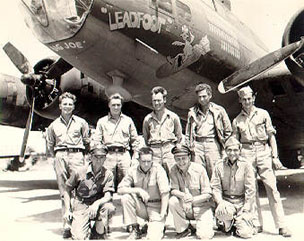
Editors Note: This was the last entry in James Boston’s diary. His diary and other personal effects were returned to his next of kin by the Personnel Supply section of the 32nd Squadron. Information received later by members of the Ground Echelon revealed that plane No. 25137 had been named twice. The first name given was “Lead Foot” (Pictured below, left.) for the Crew Chief, Eugene Gardner’s nick name and the second was “Carol Jean IV” (Pictured below, right.) for the Pilot’s girl friend. Below is the official report of the lost plane and crew:
 |
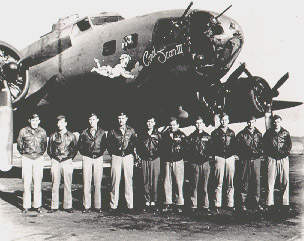 |
25137, "LEAD FOOT/CAROL JEAN IV" (Click the names to view our Nose Art Gallery, then click your "back" button to return to this page.) MIA Turin October 30, 1943 on its 86th mission. Charles Clowe crew, Wright, Boston, Robinson, Haberberger, Padgett, Service, Headding, Dill. All KIA. (MACR 1060).
The final entries in his diary are by his brother John I. Boston in 1995:
My parents received a letter from the War Department stating that he was missing in action. They said his Squadron was on a mission or returning from a mission when his plane developed engine problems. The crew bailed out in the Mediterranean. The position was noted but search planes returned but there were no survivors. Since there was a German submarine base in the area the thought was that they may have picked up and held the crew as POWs. We lived in hope that he would be released at the end of the war. About one year after the war ended my Mother received a letter from the War Department saying that the crew from one of the planes in their Squadron saw all 10 parachutes open and could see them being dragged across high waves and it was assumed that all drowned. Frank was a kind, easy going and very intelligent young man. We were very close as brothers. In my last letter from him he said he would like to go in some kind of business together. Though World War 11 ended over 50 years ago there has hardly been a day that I have not thought of him and how good it would have been to grow old with him around. John I. Boston
|
IX. The Reunion:
|
HERB HEILBRUN KEEPS EVERYTHING. He has every canceled check he ever wrote. He has the manufacturer’s manual for the B-17G he picked up at the Boeing factory in Seattle on October 12, 1944, and the flight log that records the 7,075 miles and 41 hours of his flight from Lincoln, Nebraska, to Foggia, Italy, via Newfoundland, the Azores, and North Africa. He has one of the 89 chunks of shrapnel that ventilated his bomber on Christmas Day 1944, while his squadron was attacking refineries at Brux, Czechoslovakia. He has the government-issue rubber oxygen mask and canvas flier’s helmet that he wore 30,000 feet over Brux. And he has the diary he kept to detail his 262 hours in combat, piloting a B-17G from Italy up the Adriatic, over the Alps, and into the industrial heart of Nazi Germany. He knows to the minute how long he was in combat and on what dates he flew against which targets.
IN 1995, Herb read in the Cincinnati paper that the city was honoring the local chapter of the Tuskegee Airmen. Red tails, Herb remembered. The Tuskegees were the all-black 332nd Fighter Group. They flew red-tail P-51s on missions escorting bomber squadrons from Italy into Germany. Herb could still remember hearing, amid the radio chatter over the target, the distinctive voices of the Tuskegee Airmen. He felt that his thanks were overdue.
“THE MAYOR WAS MAKING A PRESENTATION on Fountain Square,” Herb recalls. “I went down to the hotel where they were having some sort of reception and I told somebody that I flew B-17s in Italy and that the Tuskegee Airmen escorted me. I said that if there’s a flier around here that was over there, I’d like to give him a hug for saving my behind. Then someone said, ‘There’s a fellow over there. I think he did that.’”
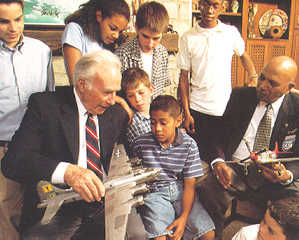
THE MAN WAS NAMED JOHN LEAHR. When the two were introduced, Herb hugged John and said: “I’ve been waiting 50 years to meet one of you guys. You saved my tail on many a day.”
THE BLACK EX-FIGHTER PILOT AND THE WHITE EX-BOMBER PILOT BECAME FRIENDS. They went out for lunch. They visited each other’s homes for dinner. They began matching up dates and other details of combat missions they’d flown. John had indeed flown cover on at least two of Herb’s 35 missions: Brux on December 16th and Blechemmer on December 17th. Brux on the 16th was bad but not as bad as Brux on the 25th, Herb recalled. On that mission – Christmas Day – his fuel tanks were hit, his high-altitude oxygen system was hit, and his armor gunner ended up getting wounded in the foot.
AS THE TWO GOT
TO KNOW EACH OTHER,
they discovered other things in common. The men had been born within a
mile of each other and only seven months apart. Both had come up
through Cincinnati public schools, and both had managed to scrape
together two years of college during the Depression. Both had enlisted
in the Air Corps within weeks of Pearl Harbor. Both had to wait months
to be called for flying school, so both took jobs at the same airplane
engine factory: Wright Aeronautical in Lockland, Ohio. Herb tested
engines, firing up GR-2600-655 Cyclones on test stands. John worked in
the plant foundry. The work was filthy, hot, and done exclusively by
blacks, he recalls.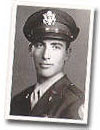
HERB GOT ASSIGNED TO ITALY as part of the 32nd Squadron of the 301st Bomb Group. He arrived well schooled in the elaborate squadron takeoff ritual that quickly launched and stacked dozens of bombers into box formations. Rising from fields all around Foggia, the bomber echelons assembled themselves until hundreds of aircraft were swarming up the Adriatic. The first time Herb saw one of the enormous boxes, it took his breath away.
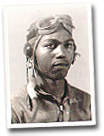 A FEW
THOUSAND FEET above the B-17s and off to the side, John
Leahr flew escort in a P-51. “I’d always wanted to fly,” he recalls.
“It fascinated me, but I’d never been up in an airplane in my life.”
Word that the corps had been forced to train blacks as pilots
electrified the black community, John recalls, and he rushed to join
the War Department’s prewar Civilian Pilot Training program. The CPT
assigned black pilots to get their primary training at the Tuskegee
Institute in Alabama. Traveling to the deep south in that era “scared
me to death,” John recalls. “There were so many stories. At that time,
there was no federal anti-lynch law, and black people were beaten up
and killed and nothing was done about it.”
A FEW
THOUSAND FEET above the B-17s and off to the side, John
Leahr flew escort in a P-51. “I’d always wanted to fly,” he recalls.
“It fascinated me, but I’d never been up in an airplane in my life.”
Word that the corps had been forced to train blacks as pilots
electrified the black community, John recalls, and he rushed to join
the War Department’s prewar Civilian Pilot Training program. The CPT
assigned black pilots to get their primary training at the Tuskegee
Institute in Alabama. Traveling to the deep south in that era “scared
me to death,” John recalls. “There were so many stories. At that time,
there was no federal anti-lynch law, and black people were beaten up
and killed and nothing was done about it.”
THE AIR CORPS WANTED ONLY ENOUGH BLACK PILOTS to fill a handful of token squadrons, so the washout rate at Tuskegee was ferocious. John’s flying career almost crashed on takeoff. “It was when I was ready to solo,” he recalls. “I was lined up to take off and I thought I’d cleared myself good. So I started down the field and then I heard a strange noise and I looked up. Here’s an airplane coming right down straight on top of me… My prop hit the tail wheel of this other airplane and made a nice clanking noise.
“MY INSTRUCTOR WAS WAY DOWN ON THE OTHER END OF THE FIELD. I didn’t think he knew what’d happened. I thought that if I didn’t get this airplane off the ground now, I would probably never fly. If you hit another airplane, what that’s a washout. So I took the plane off without checking the prop. And that plane tried to slow roll on me all the way around the field. I got it up in the air, holding full rudder and stick to keep that plane straight.”
AFTER A BRIEF FLIGHT, JOHN MANAGED TO LAND. “The instructor came running up shouting, ‘Did you his that other airplane?’ “I played dumb and said, ‘I don’t think so’… He told me the commanding officer wanted to see me. I knew what that meant. I was going to be washed out.
“I REPORTED IN THE FINEST MILITARY MANNER, and he was sitting there ignoring me for a while and then suddenly he’s roaring at me, ‘You darn near killed an instructor and another student!’ and so and so forth. He gave me a good chewing out. Then he said, ‘Go on and get out of here and be more careful.’ Man, was I happy.” In July 1943, John earned his wings.
THE FOLLOWING FEBRUARY, his squadron landed in Italy. The black airmen lived apart from the white Air Corps. “The whole crew, everyone – mechanics, cooks, squadron commander, everybody – we were completely segregated,” says John. The pilots flew hand-me-down aircraft. When John’s squadron first went into combat with the 12th Tactical Air Force in February 1944, they were the only Americans in Europe flying the cranky and obsolete P-39 Airacobra. That July, the squadron was given weary P-51Bs and –Cs left them by white squadrons trading up to the more advanced P-51Ds.
ON A MISSION, the bombers would be about two hours out when the fighter escorts caught up with them. On the intercom of his B-17, Herb could hear his gunners sight them, high above the box, cutting S turns to eat up the difference in ground speed between bombers and fighters. The escorts were supposed to handle enemy interceptors, but nothing seemed to lessen the flak. The Germans moved mobile flak units around to surprise the Allies while they were crossing the Po Valley or near the mountain passes that they followed into Austria and Germany. And once the bombers reached their target, all the anti-aircraft guns on earth seemed to be waiting for them, altitude fuses set. It was the engineer’s job to dress the pilot for the bomb run – helmet and a heavy flak jacket shaped like an umpire’s chest protector. Herb would tuck the tail between his legs, then continue on with his squadron toward the target.
“YOU'D SEE
THOSE POOR BOMBER BOYS
line up and go straight into that flak,” John says. “It would be a
beautiful clear day and you’d look up into a blue sky, it would be
beautiful. But when those bombers would line up, it would look like one
hell of a thunderstorm where that flak would come up bursting. And
those bombers would fly right through it.
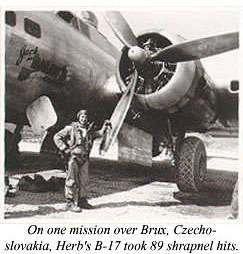
“WE WATCHED THOSE GUYS GO THROUGH HELL.
We’re sitting out on the side waiting for them to come out and we could
see them getting hit. If they got hit in the bomb bay, the plane just
exploded into a great big ball of fire. The whole plane blew up and
then it was nothing.
“WHEN THEY CAME OFF TARGET, that’s when the enemy fighters used to really get them. These guys would come off the target all shot up. Maybe they’d have a couple of engines knocked out. Maybe on fire. That’s when we would try to pick them up. They’d call us ‘Little Friend’ – ‘Little Friend, I’m going down.’ Or ‘Little Friend, I’m losing altitude. Can you see us? The pilot’s dead. Or the copilot’s injured. Stay with us. Little Friend, stay with us.’ That’s when those enemy fighters would come to shoot those poor guys down like sitting ducks.
“SOMETIMES THEY COULD GET THE PLANE together and get away from the target. Some might crash-land it if they could find a good place or some would bail out all together safely. In some instances, we were able to escort them far enough from the target so that they could make it on back. We would be running out of gas. We knew to the minute how long we had before we wouldn’t make it back ourselves. The stragglers would be very slow, traveling on two engines, but we stayed with them long enough to get them out of range of enemy fighters.” The Tuskegee squadrons, John says, never lost a bomber they were escorting home.
JOHN WAS EVENTUALLY RETURNED TO THE STATES so he could get advanced training to become a flight instructor at Tuskegee. He found that the racial climate back home had not changed. He recalls an incident in Memphis, where he had been sent by the military for a goiter operation. While convalescing, he and three other black officers had gone into town, and at a bus stop were accosted by a drunk. “He was a big redneck, a thug if there ever was one,” John says. “He stopped the four of us while we were waiting to transfer, right down there in the heart of town. We were in uniform. I was in full dress, with my decorations on, when this guy comes up and says: “I’ll be damned. Look at these niggers. And nigger officers.’ And then he says: “Two of them got wigs on. Damn, I’ve killed a lot of niggers, but I never killed any nigger officers. I’m gonna kill you niggers’” Luckily, the intervention of a passing white sailor and the arrival of a bus allowed the officers to escape.
ONCE HE WAS OUT OF THE MILITARY, John discovered that he was a pretty good salesman. He sold securities and managed a brokerage office before retiring as an office administrator from Cincinnati Gas & Electric. Herb became a salesman too, selling radio ads and then commercial real estate (He’s still doing a deal or two.) Today, John is a widower with children and grandchildren, as well as his step-children and step-grandchildren, plus the kids who attend his wife Carol’s in-home daycare center. When their paths crossed at the Tuskegee Airmen’s reception, the men were living 10 minutes apart.
ONE NIGHT, HERB RECALLS, “Johnny and I were having dinner, and he said, ‘You know, I grew up in Avondale.’ And that’s when I said, ‘So did I.’ And I remember what he said: ‘There were only five black families in Avondale, and I went to a school on Clinton Springs Avenue. It was an old mansion.’ And I said, ‘I went to that school. I lived on Warwick right where it came into Clinton Springs, and I would just walk up Warwick and right into school.’ Well then he said, ‘I don’t remember you.’ And I said, ‘I don’t remember you.’”
THAT WASN'T SURPRISING. When it came to racial matters, Cincinnati had Southern ways. During World War II, Cincinnati’s railroad station had the distinction of being the southbound point where passenger segregation began. Most of Cincinnati’s hotels, restaurants, and even hamburger stands were for whites only.
STILL AFTER HERB LEARNED that he and John had gone to the same school, he wondered if they had ever intersected. When he got home he went through his photo albums, of course he still had his second grade picture.
THE PHOTOGRAPH shows 40 kids in the class; 38 are white and two – a boy and a girl – are black. John recalls what happened next: “Herb sent [the picture] to me with a little note that said, ‘John, this thing is getting crazier and crazier by the minute. If that little black guy in this picture is you, well, that kid behind him who is almost touching him is me.’” It was true.
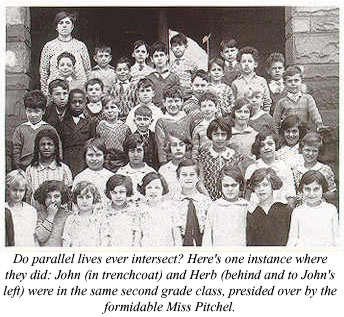 TODAY,
JOHN AND HERB take out the picture to show a visitor.
“So that’s me right there, and that’s Herb right there,” John says,
tapping the white boy with the home-barbered bangs standing right
behind him. Their teacher is in the back row. The two agree that Miss
Pitchel was a tough cookie.
TODAY,
JOHN AND HERB take out the picture to show a visitor.
“So that’s me right there, and that’s Herb right there,” John says,
tapping the white boy with the home-barbered bangs standing right
behind him. Their teacher is in the back row. The two agree that Miss
Pitchel was a tough cookie.
“AND SEE THAT BLACK GIRL THERE?" SAYS HERB. “I remember her name was Mary Louise Hillman, because my mother’s name was Mary Louise Heilbrun.”
“HERB, DO YOU KNOW SHE'S STILL LIVING RIGHT DOWN THE STREET from the school on Clinton Springs?” says John. “She’s not in the same house she was living in but she’s in the same neighborhood.”
“NOW ISN'T THAT SOMETHING?” says Herb, admiring the photo again. “This was 1928. That’s a few weeks ago.”
FOR THE LAST 25 YEARS, John has been campaigning to tell people about the role of the Tuskegee airmen in World War II and in the country’s racial history. Time is the enemy now for the Tuskegees. These are their last years to speak for themselves, putting on record not just their valor at war but the ugliness they confronted at home.
AFTER THE TWO REUNITED, John enlisted Herb in his campaign. Together, they speak at schools, clubs, and to any other group that will listen. The Kroger Company in Cincinnati had them address a corporate banquet.
TODAY, THEY ARE SCHEDULED TO SPEAK at the suburban Cincinnati campus of Raymond Walters College. Herb is waiting in the driveway when John drives up. John climbs out to contemplate Herb’s nearly vertical backyard that drops into a ravine. “I mowed that once a week for 30 years,” says Herb. “Then I hired this kid to do it for me. I got smart.”
“YOU GOT OLD,” says John.
THE TWO LOAD THE CAR with their Tuskegee Airmen displays and take off. John drives like a pilot, checking the instruments, scanning the horizon, and carefully watching his tail. THEIR COLLEGE AUDIENCE TODAY turns out to be senior citizens enrolled in an “Institute for Learning in Retirement” course on World War II. At first it seems John and Herb will be preaching to the choir, until they observe that many taking their seats in the lecture hall see to be only in their early 70s – too young to have gone to their war. Which is fine with John and Herb. Fresh ears are always in short supply.
JOINING JOHN AND HERB TODAY IS LESLIE EDWARDS, a Tuskegee ground crew chief who witnessed the nearly forgotten 1945 “Freeman Field Mutiny.” On a small training field near Seymour, Indiana, 162 black officers were court-martialed after refusing the base commander’s order to sign a pledge that they would stay away from the whites-only officers’ club. (The NAACP sent Thurgood Marshall to their defense, and though a handful of officers were convicted, General George Marshall eventually overturned the convictions.)
JOHN BEGINS BY SHOWING A VIDEO – a segment from a TV documentary on the Tuskegees. He talks about his training, about shipping out, and about getting jumped over Linz, Austria, by 40 German Bf 109s. Two of his wingmates were shot down at once, his flight leader was driven off, and, surrounded by enemy aircraft, he discovered that his machine guns had frozen at the high altitude and were unable to fire. He tells the audience that he owed his escape to a mixture or aerial acrobatics and applied religion.
WHEN IT'S HERB'S TURN, he tells the audience about the bomber war. He tells them about the wooden boards in the briefing room where each crew member’s last name was posted on a metal strip; one morning Herb watched the operations officer take down a stack of strips and toss them in the trash. They were shot down, the officer explained. They’re not coming back. Herb reaches into his pocket and with a grin holds up a battered metal strip with “Heilbrun” written in white. The audience claps.
HE TALKS ABOUT HIS HOMECOMING IN 1945, about meeting John all those years later, and about piecing together their past. Herb puts up a projection slide of the photograph of Miss Pitchel’s class. The picture never misses.
GETTING TO KNOW JOHN and hearing about the Tuskegees’ war opened his eyes, he says. “He gave me a real education. I’m an honorary member of the Tuskegee Airmen, and I consider it a great honor.
“IN ALL THOSE MISSIONS, I was never under fighter attack,” he says. “If it weren’t for men like John Leahr, I wouldn’t be here. So that’s one reason I like John Leahr. Actually that’s the main reason I like John Leahr.” They hug. The audience laughs.
ONE ARM AROUND JOHN, Herb says that the two have one request. “Don’t forget us,” he says.
Reprinted from Air and Space/Smithsonian,Vol. 16, No. 3, August/September 2001, pp. 26-29. Copyright � 2001 by John Fleischman. Reproduced with the kind permission of the author.
Text taken from Art's Diary Entries and published in His Book
Shadow Casters Published Jan 2000
Shadow Casters Reunited is in the works and should be out soon.
February 1st
to the
13th, 1944
I worked details of all kinds. We
set up our tent on an Italian farm. We
had made an overnight raid on the farmer’s big, beautiful haystack,
stuffing the hay into our mattress covers for a more comfortable sleep.
The next morning the farmer came to complain about his
vanished haystack. We sent him on
his way with no compensation.
I checked the bulletin board
every
day to see if my name was on the Battle Order for my first
The weather is cold at night, but not bad in daylight. We were fortunate to have a nice, dry bed. The poor fellows on the ground up on the front lines sure didn’t. The food was fair. A lot of things like eggs, milk and potatoes were powdered, but we had three meals a day, along with salt tablets and the ever present Malaria pills, bad coffee and bad water.
In regard to heating our tents, we had on our field an 80,000 gasoline storage tank which should have 100 octane gasoline for the planes. Somehow the octane was not up to par, so we were told we could use this gas for heating. We were getting gas from this big tank outlet pipe of about three inches in diameter, trying to fill a five gallon Jerry gas can. A lot of waste but it sure helped to keep us warm.
My first combat mission. The moment of truth had finally arrived. I was scared but eager to get airborne, not knowing what to expect, hoping for the best for all of our crew. We had a good breakfast. Always on mission days we received a good breakfast. Then a cold ride on a truck out to the aircraft. Waiting for us, and loaded with bombs were the beautiful B17’s.
Finally, we are airborne and
begin
the formation pattern with the other aircraft. The
formation separated just enough to for all gunners
to test fire our machine guns. We
will go on oxygen at 10,000 feet. As
we enter enemy skies, we watch for German airplanes.
Our primary target is
We hit the railroad yards here we ran into fairly heavy flak and ran into 28 enemy ME109’ fighters . I got away a few shots at them, then our P47 escort took over for us. My journal entry for this flight reads, “I was scared as hell.” But it was a good mission.
We had a number of flak holes in our aircraft. One hole in the wing was big enough to stick an arm in. It was very cold at 50 degrees below zero.
On
the way home I saw
From 1944 one of the major causes of B17 casualties was anti- aircraft fire from the ground. The German word for this was (Fleigerabwehrkannon.) This was shortened to the word, “flak” which was picked up by the allies and a new word entered the language.
LAST
These will be my last
missions.
Number 49 and 50. I prayed for it to get all of us through
this one safe and sound. But it was
five hours and 30 minutes of Hell and Destruction. As it turned out,
this mission is to the Airdrome in
……..It was almost the last time I would fly again. Anywhere ........
For Gallantry In Action and Heroism In Aerial Flight
In The Mediterranean Theater Of Operations.
For gallantry in action on
THE CREW
MEMBERS FOR THIS
John W. Kelly,
First Lieutenant, 32nd Bomb Squadron, 301st Bomb Group.
Residence at time of appointment:
John H.
Kletke, JR
Second Lieutenant, 32nd Bomb Squadron, 301st Bomb Group.
Residence at time of appointment,
Richard J.
Larkin,
Second Lieutenant, 32nd Bomb Squadron, 301st Bomb Group.
Residence at time of appointment,
Robert S.
McArthur,
Second Lieutenant 32nd Bomb Squadron, 301st Bomb
Group. Residence at time of
appointment,
Elliot L.
Bryan,
Technical Sergeant, 32nd Bomb Squadron, 301st Bomb Group.
Residence at time of enlistment,
Clarence L.
Murphy,
Technical Sergeant, 32nd Bomb Squadron, 301st
Bomb Group.. Residence at time of
enlistment
Albert F.
Bernard,
Staff Sergeant, 32nd Bomb Squadron, 301st Bomb Group.
Residence at time of enlistment,
K. J. McClure,
Staff Sergeant, 32nd Bomb Squadron, 301st Bomb Group.
Residence at time of enlistment,
Eugene McKiney,
Staff Sergeant, 32nd Bomb Squadron, 301st Bomb Group.
Residence at time of enlistment,
Arthur B.
Unruh,
Staff Sergeant, 32nd Bomb Squadron, 301st Bomb Group.
Residence at time of enlistment,
UNDER THE PREVISIONS OF AR 600-50 AS AMENDED AND PURSUANT
TO AUTHORITY CONTAINED IN CIRCULAR NO. 89, HEADQUARTERS, NATO USA 10 OF
JULY 1944, THE SILVER STAR IS AWARDED TO THE ABOVE NAMED PERSONNEL, AIR
CORPS, UNITED STATES ARMY, RESIDENCE AS INDICATED WITH THE ABOVE
CITATION, THIS AWARD WAS ON GENERAL ORDERS, NUMBER 2816, DATED 24
AUGUST, 1944.
(I would receive this award State-side at a later date with a letter from the President, Franklin D. Roosevelt.)
On the ground back at Home Base, I stood on good, old terra firma. Hardly believing what had just happened to us, I kissed the ground and kissed that bullet riddled old B17 airplane that brought us home.
The crew stood there knowing that there were only two planes that had made it back. I know we all are saying a little prayer for ourselves and for the crews that had not returned.
As I walk around the battered airplane, my knees begin to tremble and the fear that I didn’t have time for in the air takes hold of my mind and body. Gradually, the shock receded to a bearable level. I was alive! I had made it. This was my last mission. I don’t have to check the Battle Order anymore.
For this mission, our entire crew was awarded the Silver Star medal for Gallantry in Action. I would also receive a written award for valor in action from the MAAF 15th Air Force. It is signed by General Ira Eaker, Lieutenant General US Army Commanding. These awards will be given to me stateside, along with my five Air Medals. One (1) for shooting down an ME 410 German fighter bomber.
As I stand here, so many
things go
through my mind. I recall sorrow,
excitement, thrills, joy, loneliness. All
the good, the bad that has happened to me and my pals.
All the sights I have seen, all the places I’ve been.
I have wondered so many times why others go down, and I
don’t. I feel very humble and
thankful. Now my thoughts and
efforts focus on getting home to the
Note: In regard to my 50th mission, this fact occurred to myself and the crew that near the end of the war conventional German fighters were having a hard time getting at the Bombers because of the Fighter escorts. So the German High Command adopted a new tactic that the Japanese used, called ramming. The very young and the very dedicated pilots were trained to fly such planes as the Messerschmitt 109 directly at and on into the Bomber formations, firing all the way in, hoping they could survive the defensive firepower of the Bomber guns. Then they could ram the Bombers.
On my last mission there were German planes as close as fifty feet from our Bombers trying to ram us with their fighters. This is why we were able to knock so many of them out of the sky. Some of these pilots looked like mere 16 or 17 year old kids.
Some of the B17’s shot down
over
51st
On The 2nd of July 2003
almost 60
years after my last combat mission I finally took a ride in the
Commemorative Air Force's Sentimental Journey out of Flagstaf, Arizona
at the Arlington Washington Air Show for my 51st and Final Mission. I
thank Her Crew and Supporters for a memorable day for myself,
my Wife and my friends. God Bless
I thought you might be interested in this segment of a High School assignment given to my grandson since it included a segment with the 301st bomb group, 32nd Bomb squadron. He was asked to consult with Grandpa on his life as a teenager. So we sat down and tried to establish it from the fragmented memory of his 85-year-old grandpa.
March 1943, I enlisted in
U.S. Army Air Corp at age 17. At Traux Field Madison Wisconsin. Nine
months later received the pilot wings and Commission as 2nd Lt. from
the Air Corp, South East Training Command. 2 April 1944 294th AAF Base
unit Salt Lake, Utah. Assigned crew number #4409 and the following
personnel to my crew. John Anderson Co-Pilot, George Ancil Bombardier,
Bruce Howard Navigator, Floyd Smith Top Turret, Earl Kasdorf, Radio
Operator, Robert Shaughnessy, Ball Turret, Walter Merkel, Waist gunner,
Leanord Schelot, Waist gunner and Joseph Kruczok, Tail gunner. July
1944 Transferred to Hunter Field, Savannah, Ga.
The final crew checks,
physicals, operational equipment and clothing was issued and we passed
the test. I was assigned 4-engine bomber SN.44-6342 (B-17-G). Hunter
Field ground crew performed complete pre-flight and maintenance of the
aircraft and fueled it for flight. I performed ground check and flight
check with Hunter Field ground crew chief. We took special care of the
assigned aircraft since we were under the opinion that this was our
plane and we would fly it in combat. The Formal acceptance of Assigned
aircraft number 44-6342 (B-17-G) at Hunter Field, GA. On July 1944
Received orders for assignment to join the 301st Bomb Group 32nd
Bomb Squadron in North Africa. I joined Bruce Howard my navigator at
Hunter Field, GA. operations and together we established a flight plan
for the transatlantic crossing. Upon completion of the flight plan we
assembled the crew and told them about the flight plan to North Africa.
The look on their faces was one of, I hope to hell you guys know what
you are doing.
First stop was Gander
Newfoundland. Then fueled and flight checked the plane before
proceeding, after weather delay in Gander on trans Atlantic crossing.
Lots of joking about swim gear etc. during flight delay, but most of
crew had serious concerns about the flight. This was a very
intimidating undertaking for this nineteen-year-old 2nd Lt. A single
plane crossing, lots of ocean, no navigational aids, and a night time
take off for daylight arrival at the Azores. Landed in Azores @10:07AM,
3rd August. Approximately 9 hour flight over water to Air basein Azores
for a refueling. An in rout sunrise with nothing but water all around
was a rather intimidating experience. Upon landing in the Azores we
gave our navigator an “A” for flight plan, and in-flight course
corrections based on star checks and early morning drift readings from
ocean waves below. 3rd to 8th Aug 1944. We flew from the Azores to
Marrakech French Morocco, then to Tunis Tunisia and to Lucera just 9
miles north west of Foggia Italy. This was the operational base for the
32nd Squadron of the 301 Bomb Group.
At 32nd Squadron operations
check-in the Operations Officer, Donald Ewing informed us that there
would be no permanent plane assignments and we were expected to fly any
bomber judged to be operationally ready for the assigned mission
target. Our plane SN #44-6342 was taken over by Major Harding and
Amazin Maizie nose art was attached. We were scheduled combat flight
assignments regularly from 10 Aug 1944, one day after check in, through
20 January 1945 ending our combat tour with the completion of 50 combat
missions in six major European air operations. These air operations
were Rome Arno, Rhineland, North Apennines, Southern France, the
Balkans, and the air war over Germany. The total combat flight hours
logged was 236 hrs 20 min.
Upon combat tour completion
our crew was intact except for our navigator Lt. Bruce Howard shot down
flying as lead navigator with another crew and Lt. George Ancil
relieved from active combat flight duty. Lt. Howard escaped capture and
was later returned to the squadron. As I try to recall individual
combat missions flown from notes I found in some old papers, they all
seem now at the age of 85, as one big block of memories. The mission
dates I was able to establish seem to be awful close together but I do
recall flying combat missions almost daily. The mission dates recorded
by Donald Ewing, operations officer in December of 1944 upon combat
assignment completion were as follows. Aug. 13, 16, 18, 20, 21, 23, 26,
28. Sept. 1, 5,
10, 11, 12, 13, 14, 18, 20,
21, Oct.10, 11, 12, 13, 14, 16, 17, 20, 23, 25. Nov. 4, 5, 7, 16, 18,
20, 22. Dec.11, 16. Most of these missions were flown with the
originally assigned crew. On some missions members of other crews were
used to fill out our crew. Some mission targets seem to stand out in my
memory at this time
as difficult missions but I
cannot seem to separate their associated actions. Those that stand out
in my memory are highlighted below. I can’t recall any freebies or milk
runs and I will attempt to note the most
memorable targets best as I
can. 13 Aug 1944.
Our 1st combat mission,
Target Savona, Italy. Our crew was assigned this mission two days after
arrival, no ck- out or pre -combat flight prep. I did not know or speak
with any of the flight crews assigned to this mission prior to the
preflight briefing. The preflight operational briefing was brief with
Target description rout to target IP, bomb run and exit rally point,
every thing seemed overwhelming. This first mission was an eye opener
to this young pilot, many aircraft fully bomb loaded, fully fueled,
planes flying extremely close together during formation assembly above
the air base. Planes seemed to be going over, under and sliding up to
you from all directions before settling into a six-element formation
and joining up with two other 6 aircraft elements for the groups
entrail climb to our assigned altitude and flight to the assigned
target.
To me this first flight
assembly routine was a frightening experience. 18 Aug 1944 Target
Ploesti Rumania Oil Refinery (Deep penetration rough target) Thoughts
about the possibility of not reaching the age of 20 settled in. Next
day or remainder of the week thinking replaced long-range planning.
This third mission was a real wake up call to air combat and the effect
of an unchanging bomb run into a heavily defended target. 20 August
1944 Target Oswiecim Refinery, Poland (Deep penetration double
mission). I thought being a fighter pilot might have been a better
assignment, as I became aware of our escort flying above the flack and
their shorter mission flight times. The unvarying altitude and
airspeed, straight and level flight from the IP to target were a
problem and anxiety of mine. Bomber Aircraft during this phase were
very easy targets. 10 September 1944 Lobau Refineries Vienna Austria
(Deep penetration double mission). Vienna targets were always rough
ones, remembered as heavily defended, lots of flack and opposition. 13
Sept 1944 Blechhammer, North Oil Refinery, Germany (Deep penetration
double mission). 13 October 1944 Blechhammer, Germany (Deep penetration
double mission).
14 Sept 1944 promoted to 1st
Lt. 17 October 1944 Blechhammer, Germany (Deep penetration double
mission). Mission duration 9 Hrs. This would be our third trip into
this target. This mission was a repeat of the first two. The missions
are long and fighter escort short duration. Flack and opposition big
problem due to triple visit and the same scripted flight plan to and
out of target area as the two previous missions. On one of these
missions I recall the fighter escort was forced to drop its external
tanks as German fighters in the northern Adriatic region engaged us.
This shortened their escort time considerably. 20 October 1944 Brux Oil
Refinery, Germany (Deep penetration double mission). Mission duration 9
Hrs. Back into the long deep penetration flack and opposition in and
out of target area. We always seemed to hit target areas around noon
and come in from the north and rallying out to the southeast. Target
area scripts never seemed to change.
Altitudes over target
22,000, or 24 or 26,000 ft. Groups in trail. I always had a problem
with this repeated scenario. 22 November Regensburg, Germany. Difficult
target. There was one mission I recall where we took a bigger hit than
usual but can’t remember which one. This may have been it. 18 November
1944 Florisdorf Refinery, Vienna Austria (Deep penetration double
mission). The Vienna refineries were always heavily defended. To me
Vienna will always be remembered as big trouble not great music. 16
December 1944 Brux, Czechoslovakia (Deep penetration double mission).
Mission duration 9 Hrs. This was our last assigned combat mission. This
was a mission filled with high anxiety and nervous apprehension. I
recall the opposition flack was moderate to high, aircraft damage
slight, trip home uneventful. Shouts of we did it at engines off.
Everyone was in high emotional spirit and looking forward to going
home, combat tour completed.
January 1945 I was awarded
the Distinguished Flying Cross, Received the DFC from General Lawrence.
Upon presentation he asked, how old are you? I do remember the
expression on his face when I told him I was 19. 21 January 1945 – Crew
# 4409 minus our navigator and bombardier received orders transferring
us to Naples Italy unassigned, to await transport by troop ship back to
USA. I had completed my combat tour with 50 combat missions and 263hrs,
20min of combat flight hrs. The Distinguished Flying Cross, Three Air
Medals and the European theater ribbon with silver star for
participating in combat missions of 5 major air campaigns. I do
recognize some of the names on your web sight, Joe Brensinger and
colorful crew who occupied the tents next to ours. He shipped out of
Hunter Field GA. At the same time as our crew, July of 1944.
Lt. Ewing was the operational officer
and Col Harding the C.O. I do remember but many others I do not recall.
Since I am now 85 years most of my squadron associates are no longer
available and I don’t recall any other names listed on the 32nd web
sight. However, the information on your site was interesting. I wish I
could be more definitive for this teen age period in my life with the
301st Bomb Group, 32nd Bomb Squadron. If there is anyone out there that
can fill in the blanks I would appreciate their help. Robert O.
Schwantes April 8, 2010.
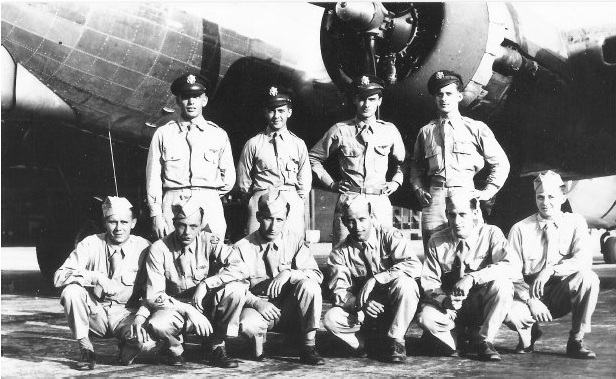
Top
Row left to Right: John Anderson Co-Pilot, Bruce Howard Navigator, George Ancil
Bombardier, Robert Schwantes Pilot.
Front Row: Joseph Kruczok
Tail gunner, Floyd Smith Engineer Top Turret gunner, Robert Shaughnessy
Ball Turret, Earl Kasdorf Radio Operator, Leanord Schelot Waist gunner
and Walter Merkel Waist gunner.
A
month after Allied forces landed on the shores of France in 1944 and
began their push towards Berlin, Germany, American
Forces launched bombing raids on airplane factories in Wiener Neodorf,
Austria.
During
the course of these raids, some 425 bombers of the 15th Air Force were
sent on missions. Two of those planes, AAF
Serial No.42-3157 or "Laura" and AAF 4232107 crashed in the eastern
region of Styria near St. Jakob im Walde, Austria
on July 26, 1944.
Bill
Brainard, a radio operator on Laura, now of West Palm Beach Florida,
recalls his memories of that day. The plane carried
a crew of a 10, five of whom would perish, including the pilot Captain
Leo J. MacDonald of Elgin. Brainard's
harrowing tale reminds us of the sacrifices made by many of our
veterans.
"As
a member of the 15th USAF, the 301st Bomb Group H, 32nd Bomb Squadron,
I was assigned to be the radio operator
on a make-up crew to take part in an air raid July 26, 1944 on an
aircraft engine factory in Wiener Neudorf, Austria.
We would be flying in a B-17F serial No. 42-3157 with the name of
'Laura.' She was then commonly referred to as
simply No. 157 in many records, by its crew and also by the men in the
air control towers. Our airfield and base of operation
was located in the Italian town of Lucera, a neighbor of Foggia.
At
the mission briefing, after breakfast at 4:30 a.m., we learned which
plane we would be flying in and also that 1st Lt. Leo
J. McDonald would be our pilot. Our co-pilot would be 2nd Lt. Kenneth
B. Kai-Kee. Also on board were 2nd Lt. Thomas
J. Steed as the Navigator, 2nd Lt. Richard C.Winsor as the Bombardier.
The Engineer and top turret gunner would
be T.Sgt. Johnny E. Allen.
These
five crew members are all positioned to the rear of the bomb bay. The
Radio Operator/gunner would be T. Sgt. William
W. Brainard, the ball turret gunner would be S. Sgt. Edward W. Forys,
and the waist gunner on the left side would be
S.Sgt. Edward M. Shallcross and S.Sgt. Wallace A. Tate on the right
side. Last, but not least, the tail gunner would be S.Sgt.
William H. Jameson. These five crew members had stations aft of the
bomb bay. Other info regarding the mission was
also delivered.
After
the briefing, Gl trucks transported the crews and their flight gear to
their particular plane. In general, each plane was
deemed ready to fly, but the crews were to inspect their station and
report any problems they might find to the ground crew
chiefs standing by each plane. Prior to boarding the aircraft there was
usually time for the flight crew to gather under one
of the wings to have a little chat session, ten minutes perhaps to get
to know each other a little better. Lt.
McDonald led things off by introducing himself and telling us a little
about his experiences flying similar type bombers
in the Aleutian Islands combating the Japanese. I don't think all of us
even knew that we were fighting in that battle
zone. We were highly interested to learn of his flying experience
finishing a tour of 50 missions or so. It gave us more confidence
in his ability to fly.
Then,
Bill Jameson started telling us that this mission we were headed out on
would be his 51st and he had volunteered to go
on it because he could go home afterward.
By
the way, it was Ed Forys's first mission. He added how lucky he had
been so far. I recall that Lt. McDonald spoke up quickly to
say facetiously, words to the effect that he would not like to hear him
talk about how lucky he had been. He went on to say that one
of his flying buddies in the Aleutians had mentioned how lucky he had
been just prior to going on a mission and he never came
back. That turned out to be a rather prophetic statement.
Soon
thereafter we were in the air on our way to the target. Shortly after
crossing the Austrian border at about 5 minutes to 11 a.m.,
I was scanning the skies off our left wing. Way out at 9 o'clock level
coming out of the clouds I spotted con trails probably nine
to 10 miles away. I notified the pilot right away over the interphone
system which everyone would hear. He came back calmly,
"I see them now; I hope they are our escort!" And, those were the last
words that our makeup crew would hear from Leo.
I
switched back to our base radio channel to pick up an 11 a.m. signal
for my log but I was worried about that 'hope' word from Lt. McDonald
so I switched back to the interphone just in time to hear the tail
gunner yell, "They look like ME-109s; God (expletive) they
are ME-109s!" And the machine guns started blurting their fury - both
ours and the enemy's. I
grabbed the radio gun and started firing at an echelon of six to eight
German fighters that were sitting on our tail about 50 to 60 yards
behind and above our turbulence. We could see the 109 guns six to eight
mounted in the wings spitting bursts of fire with every
tracer bullet they fired.
My gun only held about 75 to 100 rounds and they were getting low. It was also getting time to get the chute on. While reaching for my chute on the floor, the plane gave a quick lunge upward and the floor came up to meet my face. I was pinned to it for several seconds and when I could move again I glanced upward and noticed through the bomb bay door that the bomb bay was no longer there. Looking down I could see the front end of "Laura" headed earthward at a steep angle, engines still running it seemed. I looked to the rear and the tail too was missing and I could see none of the crew so I squatted on the door threshold, grabbed my knees and rolled out.
I
delayed pulling the rip cord until I had gone way down stairs, perhaps
to 1,000 feet. My chute opened gently and I was drifting in the
direction I was facing. I happened to land on a farm's newly mowed
field which was lucky for me because there were
many trees nearby. It was a perfect landing.
However
for Lt. McDonald, Lt. Kai-Kee, Lt. Winsor, T. Sgt. Allen, and S. Sgt.
Forys, Richard Winsor it was a horrible landing. They were all killed
in action and we that lived often have to wonder, "Why them and not
us?"
|
Crew
of B-17 F 42-3157 “Laura” (BS32)
Crash site: St. Jakob/W., Schaberreiter (Kropfhofer) KILLED
IN ACTION (26.7.1944)
|
||
 ●Leo J. McDonald,
Pilot (IL, USA) ●Leo J. McDonald,
Pilot (IL, USA) |
ID 01683543 | buried in St. Louis/USA |
 ●Kenneth
B. Kai-Kee, Co-Pilot (CA, USA) ●Kenneth
B. Kai-Kee, Co-Pilot (CA, USA) |
ID 0-756250 | buried in St. Louis/USA |
 ●Edward
W. Forys, Ball Turret Gunner (RI, USA) ●Edward
W. Forys, Ball Turret Gunner (RI, USA) |
ID 11110502 T 43-44 | buried in St. Avold/F |
 ●Richard
C Winsor, Bombardier (FL, USA) ●Richard
C Winsor, Bombardier (FL, USA) |
ID 0-751954 | |
 ●Johnny
E. Allen, Engineer (FL, USA) ●Johnny
E. Allen, Engineer (FL, USA) |
ID 14000100 | buried in St. Louis/USA |
| SURVIVORS: | CAPTURED: | |
| ●Thomas J. Steed, Navigator (IL, USA) | ID 0-712123 | Waldbach 12:50 |
| ●William W. Brainard, Radio Operator (FL, USA) | ID 14107284 | |
| ●Milton Edgar Shallcross, Waist Gunner (OH, USA) | ID 15324659 | Waldbach 12:50 |
| ●Wallace A. Tate, Waist Gunner (OH, USA) | ID 15332197 | Waldbach 12:50 |
| ●William H. Jameson, Tail Gunner (SC, USA) | ID 14125486 | Wenigzell 13:15 |
 …….buried in the cemetery of St. Jakolb im Walde, (exhumed after war)
 …….not identified at the time of burial in St. Jakob im Walde
 |
||
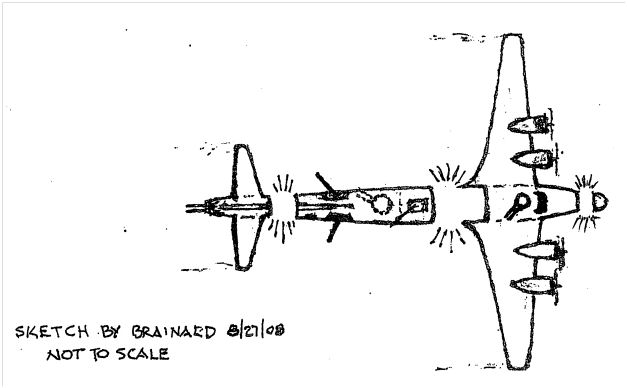
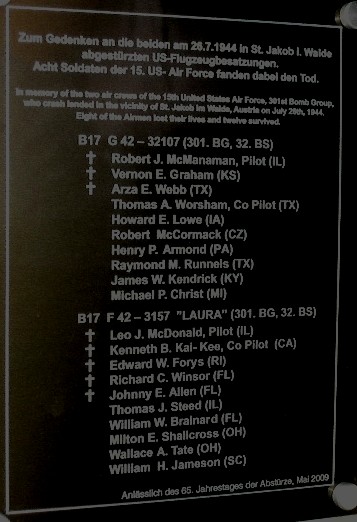 Last
year 2009, May 30th, in the ancient rural town of Saint Jakob im Walde,
Austria, there was a commemoration planned by the town folks and the
area veteran organizations rejoicing in 64 years of peace since WW II.
At the same time they would be honoring their Austrian war veterans,
they also would pay respect to the veterans from each side of the war
who had engaged in a horrible air battle above their town on the day of
July 26, 1944. That day two American B-17 bombers crash landed in the
farming fields nearby the town. Each of those planes had a ten man crew
and I was a member of one of the crews. The memorial plaque to be
dedicated in their honor lists the names of those fliers who were
killed in action and those who survived the turmoil to live another
day. And while the people would be in a joyous mood they would also
happily celebrate their beloved town’s 800th Anniversary WOW! For the
Town celebrations the known living American crew members or close
relatives thereof, were cordially invited to the ceremonies by the
Town’s people. Hence, the Brainard’s, Rainey & Bill, from
Florida
and the
Last
year 2009, May 30th, in the ancient rural town of Saint Jakob im Walde,
Austria, there was a commemoration planned by the town folks and the
area veteran organizations rejoicing in 64 years of peace since WW II.
At the same time they would be honoring their Austrian war veterans,
they also would pay respect to the veterans from each side of the war
who had engaged in a horrible air battle above their town on the day of
July 26, 1944. That day two American B-17 bombers crash landed in the
farming fields nearby the town. Each of those planes had a ten man crew
and I was a member of one of the crews. The memorial plaque to be
dedicated in their honor lists the names of those fliers who were
killed in action and those who survived the turmoil to live another
day. And while the people would be in a joyous mood they would also
happily celebrate their beloved town’s 800th Anniversary WOW! For the
Town celebrations the known living American crew members or close
relatives thereof, were cordially invited to the ceremonies by the
Town’s people. Hence, the Brainard’s, Rainey & Bill, from
Florida
and the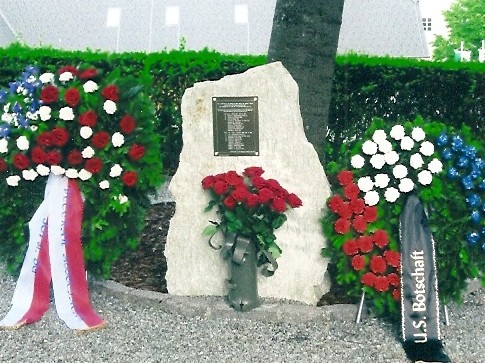 Spencer’s, Gail & Tom, from California, representing the 32nd
Bomb
Squadron, were proud to join the gathering. Gail is a second cousin of
our copilot, 2nd Lt. Kenneth B. Kai-Kee. Apparently at 87 years of age,
I was the only crew member from either plane that was well enough to
make the trip. Two of my buddies and crewmates, Ed Shallcross and Bill
Jameson, were alive but not well enough to go abroad. Ed passed on in
September 8, 2009.
Spencer’s, Gail & Tom, from California, representing the 32nd
Bomb
Squadron, were proud to join the gathering. Gail is a second cousin of
our copilot, 2nd Lt. Kenneth B. Kai-Kee. Apparently at 87 years of age,
I was the only crew member from either plane that was well enough to
make the trip. Two of my buddies and crewmates, Ed Shallcross and Bill
Jameson, were alive but not well enough to go abroad. Ed passed on in
September 8, 2009. 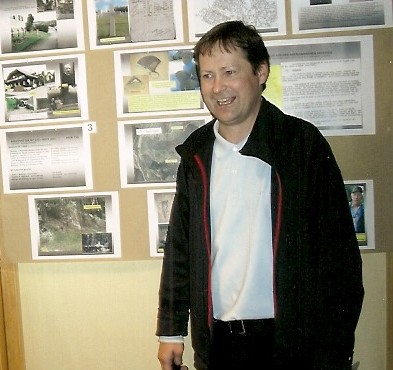 precisely the meadow where my chute and I landed, exactly where I
hid out that day until nightfall when I decided to move on but knew not
where? We learned that it was Mr. Jakob Lang, a farmer and a shoe
cobbler, who captured me the following morning about 6:00 AM as I was
stepping out of the woods to get my first sip of water in 26 hours from
a little field stream. He said, “Hallo,” and I said, “Hello,” He came
closer to me when I told him I had, “Nix pistole”. Actually we had just
a few steps to take to be at the front door of his farmhouse. There, he
offered me a drink of fresh water plus a bowl of rye cereal in goats
milk, a new type breakfast for me but I loved it. He had not wanted me
to drink the polluted stream water, I gathered. His treatment of me was
calm and firm but not antagonistic. Sitting in his kitchen, I noticed
on top of the upper cabinet two beautiful porcelain containers, one
labeled ZUCKAR the other KAFFEE. Gee, already I was able to read the
language. Christain chased down the jars to the Lang’s grand daughter’s
home, where she now has them displayed. He took pictures of the jars
and sent them to me. Probably Mrs. Lang would have been impressed that
I remembered them.
precisely the meadow where my chute and I landed, exactly where I
hid out that day until nightfall when I decided to move on but knew not
where? We learned that it was Mr. Jakob Lang, a farmer and a shoe
cobbler, who captured me the following morning about 6:00 AM as I was
stepping out of the woods to get my first sip of water in 26 hours from
a little field stream. He said, “Hallo,” and I said, “Hello,” He came
closer to me when I told him I had, “Nix pistole”. Actually we had just
a few steps to take to be at the front door of his farmhouse. There, he
offered me a drink of fresh water plus a bowl of rye cereal in goats
milk, a new type breakfast for me but I loved it. He had not wanted me
to drink the polluted stream water, I gathered. His treatment of me was
calm and firm but not antagonistic. Sitting in his kitchen, I noticed
on top of the upper cabinet two beautiful porcelain containers, one
labeled ZUCKAR the other KAFFEE. Gee, already I was able to read the
language. Christain chased down the jars to the Lang’s grand daughter’s
home, where she now has them displayed. He took pictures of the jars
and sent them to me. Probably Mrs. Lang would have been impressed that
I remembered them. 
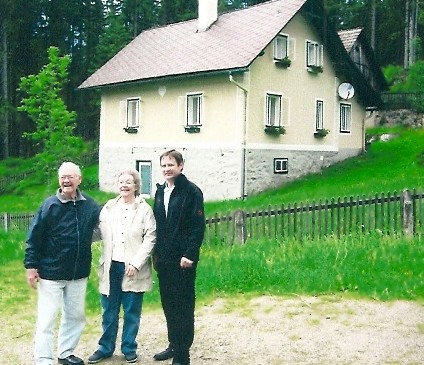 Sgt.
Ed Forys’ head set and ball turret hydraulic power lines were severed
by the plane’s ripping explosion. He had to hand-crank himself to the
interior exiting position of the fuselage. He did get out of the ball
turret but too late to get his chute on and then jump clear of the
plane. There is not room to wear a chute in the ball. He was on his
first mission and he could have been wounded, as it happened to Bill
Jameson in the tail section. Our bombardier was blown out of the nose
as the plastic nose cone broke away due to the explosion. He was not
wearing a chute. On the ground, Lt. Steed, after capture, was taken to
where Winsor’s body came to rest to identify him. Lt. Steed fighting
the wind pressure had pulled himself through that same opening in the
nose. His chute was blossoming just moments before it got hung up in
some tall tree tops, which probably saved his life. He was able to
climb down to the ground. It was reported back at Base by the ball
gunner, Albert Bernard, flying off our right wing with pilot, John
Kelly’s crew, that our plane suddenly zoomed upward 50 feet then zoomed
downward peeling to the left, then, momentarily leveled off at about
1000 yards below the formation, and then it blew apart. He saw only one
chute open and that had to have been our tail gunner, Bill Jameson, who
was dumped out of the tail section when it tore away. He has no
recollection as to how his chute got opened. Bill is still among the
living and with a piece of shrapnel still lodged in his neck. Three or
four times a year we do a little chatting over the phone. Bill
volunteered to fly that day because he wanted to get his 50 mission
tour over and get back to the States, ending up with 51 missions. It
was a double mission and turned out to be one more mission than he
needed, wouldn’t you say. But think about it, he’d have missed out
being a POW for the next nine months! If it weren’t for bad luck he’d
have no luck at all, an old quote. Since the plastic nose cone blew out
and the tail section blew away, as did the fuselage, it seems the
explosion must have taken place in the bomb bay. Probably gas fumes
ignited, because just outside the bomb bay wall, our right inboard
engine had been reported on fire by Sgt. Bernard back at Base. Sgt. Ed
Shellcross, the left waist gunner with his oxygen mask shot away and
Sgt. Wally Tate, R. waist gunner, wounded, bailed out about two minutes
prior to the explosion. Wally’s chute harness got hung up on the rear
exit door, dangling half in and half out of the plane. Ed, next to
jump, saw the problem and yanked the door jettison cable and out they
went door and all. Later I’m sure Wally said, “Thank you, Ed”. At the
crash site the tail section of our plane could also be seen in the
distance, perhaps 100 yards away, but we did not go to it. Leaving the
wreckage site we went through the woods, not too far, to the meadow
where I had drifted to earth. Mr. Lang wanted my chute. I had hidden it
in a rock out cropping. He took it away from a young lady who had just
found it. Unhappily her plans for a new silk dress were spoiled, but he
told her it had to be turned in to the authorities.
Sgt.
Ed Forys’ head set and ball turret hydraulic power lines were severed
by the plane’s ripping explosion. He had to hand-crank himself to the
interior exiting position of the fuselage. He did get out of the ball
turret but too late to get his chute on and then jump clear of the
plane. There is not room to wear a chute in the ball. He was on his
first mission and he could have been wounded, as it happened to Bill
Jameson in the tail section. Our bombardier was blown out of the nose
as the plastic nose cone broke away due to the explosion. He was not
wearing a chute. On the ground, Lt. Steed, after capture, was taken to
where Winsor’s body came to rest to identify him. Lt. Steed fighting
the wind pressure had pulled himself through that same opening in the
nose. His chute was blossoming just moments before it got hung up in
some tall tree tops, which probably saved his life. He was able to
climb down to the ground. It was reported back at Base by the ball
gunner, Albert Bernard, flying off our right wing with pilot, John
Kelly’s crew, that our plane suddenly zoomed upward 50 feet then zoomed
downward peeling to the left, then, momentarily leveled off at about
1000 yards below the formation, and then it blew apart. He saw only one
chute open and that had to have been our tail gunner, Bill Jameson, who
was dumped out of the tail section when it tore away. He has no
recollection as to how his chute got opened. Bill is still among the
living and with a piece of shrapnel still lodged in his neck. Three or
four times a year we do a little chatting over the phone. Bill
volunteered to fly that day because he wanted to get his 50 mission
tour over and get back to the States, ending up with 51 missions. It
was a double mission and turned out to be one more mission than he
needed, wouldn’t you say. But think about it, he’d have missed out
being a POW for the next nine months! If it weren’t for bad luck he’d
have no luck at all, an old quote. Since the plastic nose cone blew out
and the tail section blew away, as did the fuselage, it seems the
explosion must have taken place in the bomb bay. Probably gas fumes
ignited, because just outside the bomb bay wall, our right inboard
engine had been reported on fire by Sgt. Bernard back at Base. Sgt. Ed
Shellcross, the left waist gunner with his oxygen mask shot away and
Sgt. Wally Tate, R. waist gunner, wounded, bailed out about two minutes
prior to the explosion. Wally’s chute harness got hung up on the rear
exit door, dangling half in and half out of the plane. Ed, next to
jump, saw the problem and yanked the door jettison cable and out they
went door and all. Later I’m sure Wally said, “Thank you, Ed”. At the
crash site the tail section of our plane could also be seen in the
distance, perhaps 100 yards away, but we did not go to it. Leaving the
wreckage site we went through the woods, not too far, to the meadow
where I had drifted to earth. Mr. Lang wanted my chute. I had hidden it
in a rock out cropping. He took it away from a young lady who had just
found it. Unhappily her plans for a new silk dress were spoiled, but he
told her it had to be turned in to the authorities. 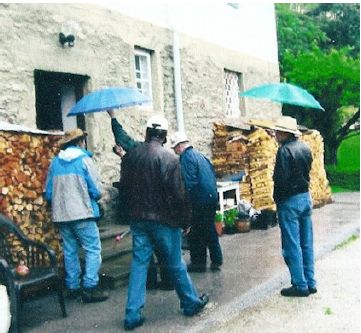 After
we put the chute in his Austrain backpack, on my back, it was on to the
Lang farm for a short while before heading into the town of Ratten’s
police station and jail for lunch and a one night stay. My next stop by
rail was to Graz, Austria for a day or two in the guardhouse of a GAF
Primary Training Base. From there by rail again, about ten POWs with
guards were off to an ancient prison in Budapest, Hungary. We were
placed in a large cell holding 25 enlisted men awaiting interrogation.
After the individual sessions were finished the group then traveled 7
days in a boxcar, our destination was Stalag Luft IV in northem Poland.
The food ration for each man was one small loaf of rye bread plus what
the guards could drum up at any station where we stopped. At Luft IV,
for the next six months we lived and slept in barracks until the
Russians broke out of Warsaw causing our camp’s evacuation, Feb. 6,
1945, Then, it was three more cold months on the road walking toward
the west for about 500 miles, sleeping in farm barns and winding up my
POW days until the war was over!
After
we put the chute in his Austrain backpack, on my back, it was on to the
Lang farm for a short while before heading into the town of Ratten’s
police station and jail for lunch and a one night stay. My next stop by
rail was to Graz, Austria for a day or two in the guardhouse of a GAF
Primary Training Base. From there by rail again, about ten POWs with
guards were off to an ancient prison in Budapest, Hungary. We were
placed in a large cell holding 25 enlisted men awaiting interrogation.
After the individual sessions were finished the group then traveled 7
days in a boxcar, our destination was Stalag Luft IV in northem Poland.
The food ration for each man was one small loaf of rye bread plus what
the guards could drum up at any station where we stopped. At Luft IV,
for the next six months we lived and slept in barracks until the
Russians broke out of Warsaw causing our camp’s evacuation, Feb. 6,
1945, Then, it was three more cold months on the road walking toward
the west for about 500 miles, sleeping in farm barns and winding up my
POW days until the war was over! 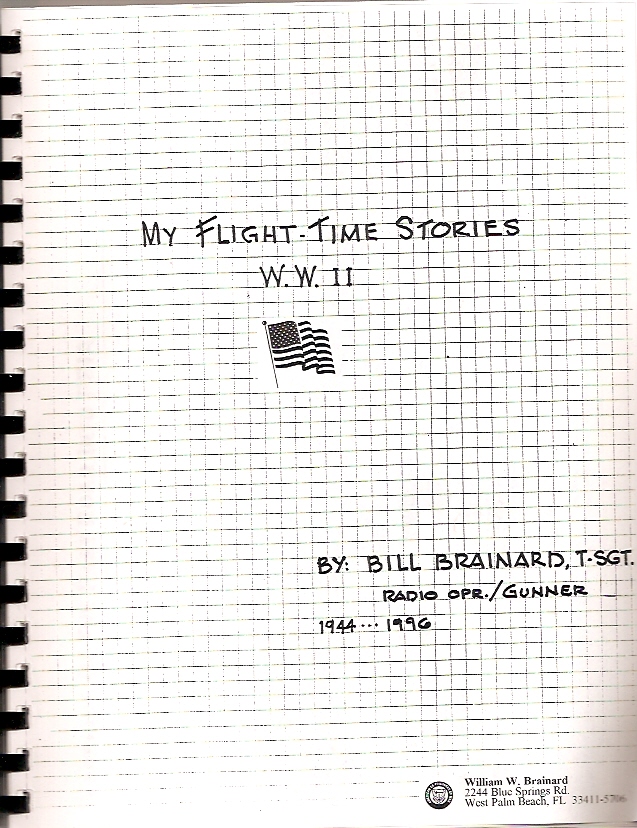 (Note:
In my book, “My Flight Time Stories”, on page 39A and page 41 are
sketches of our POW camp) It was one of the coldest winters on record
for that neck of the woods of northern Poland and Germany, snow
abounded as far as the eye could see. While hiking along on one
occasion, just prior to crossing the Oder River bridges, we 2500 POWs
stopped in the middle of nowhere and were told to bunk down on the road
side snow banks. I recall that night was February 14th, 1945, St.
Valentine’s Day and thinking, as I tried to get to sleep, it would be
nicer snuggling with your sweetheart than this pile of stupid snow. It
was good to have a pleasant thought now and then. However, woe, to the
guy whose bowels would go astray along the way. It happened so often,
one walking by hardly noticed poor devils squatting along the roadside,
cold, aching and probably messing up their only breeches with no place
to clean up, etc. The poor diet brought these problems on big time.
(Note:
In my book, “My Flight Time Stories”, on page 39A and page 41 are
sketches of our POW camp) It was one of the coldest winters on record
for that neck of the woods of northern Poland and Germany, snow
abounded as far as the eye could see. While hiking along on one
occasion, just prior to crossing the Oder River bridges, we 2500 POWs
stopped in the middle of nowhere and were told to bunk down on the road
side snow banks. I recall that night was February 14th, 1945, St.
Valentine’s Day and thinking, as I tried to get to sleep, it would be
nicer snuggling with your sweetheart than this pile of stupid snow. It
was good to have a pleasant thought now and then. However, woe, to the
guy whose bowels would go astray along the way. It happened so often,
one walking by hardly noticed poor devils squatting along the roadside,
cold, aching and probably messing up their only breeches with no place
to clean up, etc. The poor diet brought these problems on big time. 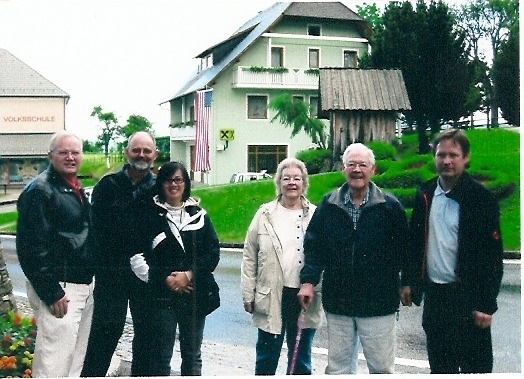 For
some unknown reason our 301st Bomb Group’s lead pilot missed getting
the Base, “RECALL” message that the raid had been cancelled due to bad
weather. Instead of the planned 425 bombers and 366 fighter escorts it
was just the 26 of us. We were out numbered about 6 to 1, and that sure
makes a difference. The all Negro fighter squadron of the 15th AAF was
alerted to come to our aid but they got there way too late. Most of our
damages came about in the first five minutes of battle. However one of
their P-38 fighter planes that did get in at the tail end of the battle
went down. The pilot became a POW like many of us that day. More than
60 years went by before I ever heard that the entire mission had been
called off. And so it was the outcome of these circumstances for two of
those flight crews that fateful day which brought about their
recognition 65 years later by the Town’s people. Some of them still
remember that air battle as it was going on over their heads.
For
some unknown reason our 301st Bomb Group’s lead pilot missed getting
the Base, “RECALL” message that the raid had been cancelled due to bad
weather. Instead of the planned 425 bombers and 366 fighter escorts it
was just the 26 of us. We were out numbered about 6 to 1, and that sure
makes a difference. The all Negro fighter squadron of the 15th AAF was
alerted to come to our aid but they got there way too late. Most of our
damages came about in the first five minutes of battle. However one of
their P-38 fighter planes that did get in at the tail end of the battle
went down. The pilot became a POW like many of us that day. More than
60 years went by before I ever heard that the entire mission had been
called off. And so it was the outcome of these circumstances for two of
those flight crews that fateful day which brought about their
recognition 65 years later by the Town’s people. Some of them still
remember that air battle as it was going on over their heads. 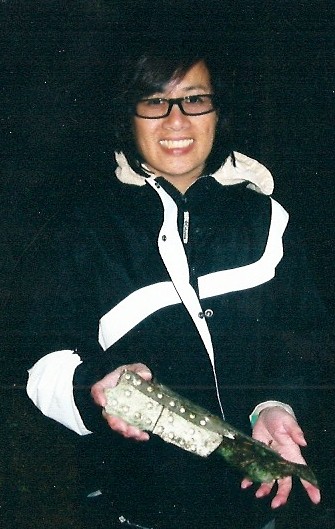 Then
back at the Hotel we prepared for our afternoon field trip. We first
drove to the meadow where I had entered their territory via the
parachute. Surprisingly after 65 years to me things looked pretty much
as they did way back when. The old Arzberger farm and the neighboring
farm are there as they were then. Then, I only saw the one farm house
since I would not stand up to look over the fence. Their two meadows
are now separated by an electrical wire cattle fence in lieu of the
beautiful split logfence I recall. Where we stopped to view the two
farm meadows at this time was the opposite end, perhaps 500 yards, from
my original landing spot The pine trees or woods serve a purpose some
of the trees are harvested when needed to provide heat in the winter.
The woods always have had a replanted pattern, then and now. The access
dome to the only underground shelter for miles, they have said, was
built jointly by the neighbors back then and is gone now. I saw people
leaving the shelter access dome after the air raid alert was over. They
excitedly entered their nearby meeting room, talking loudly in German!
It was hearing the strange language, when it hit me, I was a long way
from home and wondering what was to happen next? Back undercover of my
bush I dozed about 2 hours? Only Bossy the cow saw the stranger hanging
out in the brush.
Then
back at the Hotel we prepared for our afternoon field trip. We first
drove to the meadow where I had entered their territory via the
parachute. Surprisingly after 65 years to me things looked pretty much
as they did way back when. The old Arzberger farm and the neighboring
farm are there as they were then. Then, I only saw the one farm house
since I would not stand up to look over the fence. Their two meadows
are now separated by an electrical wire cattle fence in lieu of the
beautiful split logfence I recall. Where we stopped to view the two
farm meadows at this time was the opposite end, perhaps 500 yards, from
my original landing spot The pine trees or woods serve a purpose some
of the trees are harvested when needed to provide heat in the winter.
The woods always have had a replanted pattern, then and now. The access
dome to the only underground shelter for miles, they have said, was
built jointly by the neighbors back then and is gone now. I saw people
leaving the shelter access dome after the air raid alert was over. They
excitedly entered their nearby meeting room, talking loudly in German!
It was hearing the strange language, when it hit me, I was a long way
from home and wondering what was to happen next? Back undercover of my
bush I dozed about 2 hours? Only Bossy the cow saw the stranger hanging
out in the brush. 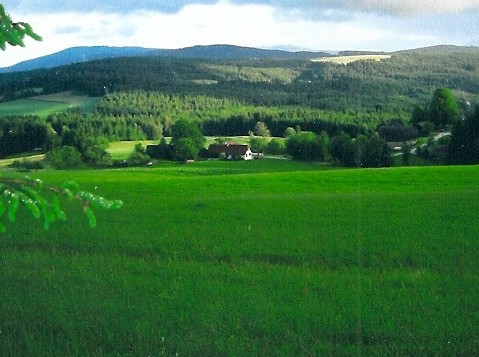
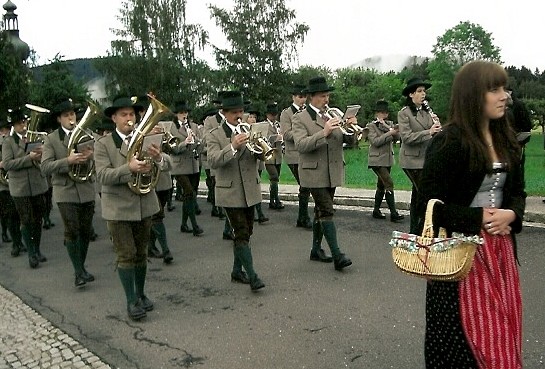 mbered,
was the detention cell where I once slept the night away that July 27,
1944. I mentioned that the sloped built-in-bed I had slept on was
missing. Our interpreter replied indicating they had only removed that
wood bunk bed about two years ago. Today the cell is their firewood
storage area. To me it was rather an eerie sensation being in the cell
once again but it was reassuring that I could leave when the visiting
was over. Our mission was accomplished. It was then time to drive back
to the Hotel and ready ourselves for the main evening ceremonies, the
big parade, the plaque dedication and the huge banquet. By the way we
discovered interestingly that Gert our TV photographer had spent a part
of his life in the Chicago, Illinois, area.
mbered,
was the detention cell where I once slept the night away that July 27,
1944. I mentioned that the sloped built-in-bed I had slept on was
missing. Our interpreter replied indicating they had only removed that
wood bunk bed about two years ago. Today the cell is their firewood
storage area. To me it was rather an eerie sensation being in the cell
once again but it was reassuring that I could leave when the visiting
was over. Our mission was accomplished. It was then time to drive back
to the Hotel and ready ourselves for the main evening ceremonies, the
big parade, the plaque dedication and the huge banquet. By the way we
discovered interestingly that Gert our TV photographer had spent a part
of his life in the Chicago, Illinois, area. 
 Since
I was the only living crew member able to be present on the dedication
day I had the honor of removing the veiled dignity clothe from the
monument. At that moment of unveiling there was a rifle salute by the
Honor Guard. It was an emotional time for all those present and I felt
especially honored. Christian Arzberger and I spoke to the gathered
people about the historical background of the dedication ceremony and
my small part in it. Following the parade and ceremonies everyone was
invited to the dinner banquet. The building was huge and nearby. The
main course of the meal was a delicious steak. One of the bands played
on into the night. There were speeches, food, singing, beer and
laughter. Too soon the party ended, all enjoyed the fun.
Since
I was the only living crew member able to be present on the dedication
day I had the honor of removing the veiled dignity clothe from the
monument. At that moment of unveiling there was a rifle salute by the
Honor Guard. It was an emotional time for all those present and I felt
especially honored. Christian Arzberger and I spoke to the gathered
people about the historical background of the dedication ceremony and
my small part in it. Following the parade and ceremonies everyone was
invited to the dinner banquet. The building was huge and nearby. The
main course of the meal was a delicious steak. One of the bands played
on into the night. There were speeches, food, singing, beer and
laughter. Too soon the party ended, all enjoyed the fun.
XIV.
Rommel’s
Defeat
in North Africa
A see-saw series of battles for control of Libya and parts of Egypt reached a climax in the Second Battle of El Alamein when British Commonwealth forces under the command of Lieutenant-General Bernard Montgomery delivered a decisive defeat to the Axis forces and pushed them back to Tunisia. After the late 1942 Allied Operation Torch landings in North-West Africa, and subsequent battles against Vichy France forces (who then changed sides). Hitler finally decided to bring Rommel home to Germany due to his illness after the Germans loss at El Alamein with the British.
On May 13 1943, German and Italian troops surrendered in North Africa. In the last week of April, the British swept through all enemy resistance as the US Forces maneuvered through the hills, while being inflected with heavy casualties, but emerged victorious. Since the Supplies had run out the Axis troops were starving and out of ammunition, the Allies Forces attacked the Axis convoys to prevent any reinforcements and supplies reaching them. In the beginning of early May they unleashed a Flurry of artillery shells before moving in the Soldier and armor Into Axis held positions.
General
Omar Bradley in the end the US lost 47
tanks. When they broke through, it was like a dame breach with a great
force
that they flooded into Tunis the capital city, completely surprising
Jerry who
put up a resistance until they literally ran out of fuel and
ammunition, as the
Germans stood defenseless. On the 12th and 13th of May after 3 long
exhaustive
years of fighting, the Afrika Axis Korps surrendered. In Tunisia alone
Jerry
lost 40,000 men and gave up 275,000 POW's, Italians included. The
British had
35,000 casualties, the French 16,000 and the US Forces 14,000.
The 301st Bomb Group along with the 32nd Bomb Squadron dropped the below safe passes by the millions. They were successful because the Italians (see below) saw that the defeat was real and gave up by the hundreds of thousands.
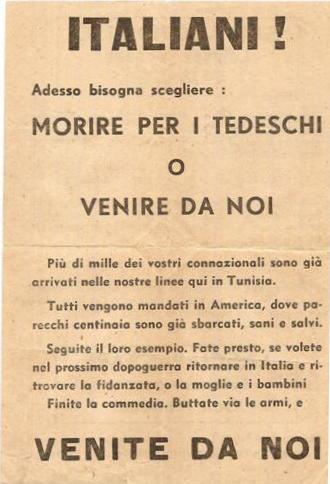
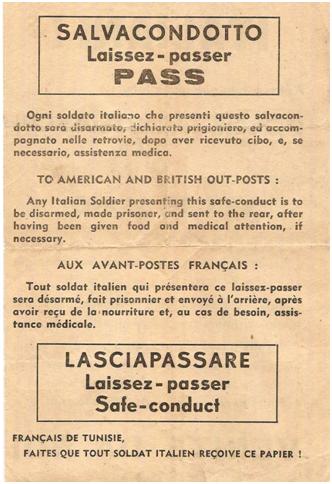
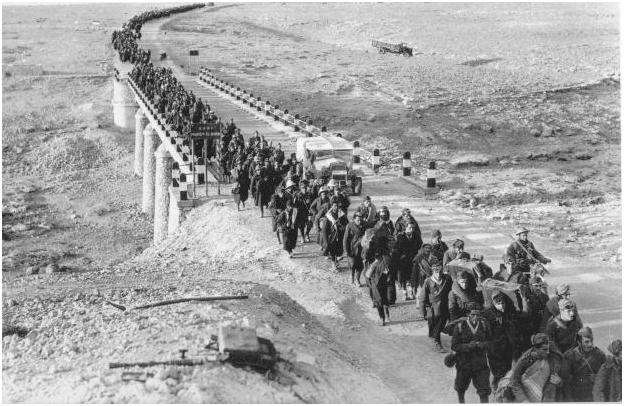
"THE SADDEST STORY YOU EVER HEARD"
By Waist Gunner S/Sgt. Edward Oulette from Lynn, Maine
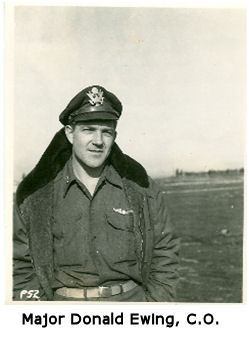 The mission to Blechammer, Germany on December 26, 1944, started out to be a routine flight and no one seemed to expect more than the usual amount of excitement. About the only thing of any concern to happen before we reached the target area, was a little display of independence by the automatic pilot. Our pilot, C.O. Major Ewing, set it up to his satisfaction only to have it pull a little maneuver of its own but outside of confusing the hell out of the formation of ships that were following us and scaring hell out of us, no harm was done.
We flew in 29-7705 De De, a mickey ship, comely know as 705 and the favorite of Colonel Harding, our ex C.O. of the 32nd Bomb Squadron. The colonel demanded that all his crew always wear a pink elephant emblem with an upturned trunk and that's what was painted on the side of the plane. It must have been of some value once the Colonel and his crew flew their 50 and finished uneventfully. Speaking of elephants, they say an elephant never forgets, and there were ten guys in 705 who'll never forget the flak that greeted us at the target.
We hit the initial point right on the button only to have to make a 360 to keep from rubbing noses with another group chiseling in on our right. "Frenchy" Oulette the Group Waist Gunner was throwing out chaff like a demon all this time, and he swears to this day that the reason the flak was so bad over the target was because we ran out of chaff before bombs away. Could be but for some reason they were hitting us with everything they had. Half way down the run the bombardier who claimed to be pretty busy all this time took time out to take note of the evidence of the gunners accuracy "this damn nose is full of holes!" He sounded like he thought he was the only guy getting shot at but there wasn't one man in the crew who couldn't count many a close hit. In fact the ship was so full of holes that if it had started raining all of us would have drowned to death. About this time when the flak really started hitting close and the ship was bouncing like a toy balloon, the bombardier asked the pilot to level the ship. Major Ewing rang out with "This so and so is as level as it's ever going to be!" Now the bombardier didn't like to doubt his word, but the ship was in about a 45 degree bank at this time and looking out the side window you could see the ground below, but the pilot said she was level-so level she was. The target was smoked over and we couldn't see it.
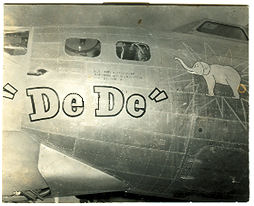 We wished and hoped the flak gunners were having the same trouble seeing us that we were having seeing the refinery but they weren't and every shell had out altitude speed, also our names, ranks, serial numbers, date of birth and shoe size. Bombs finally went away, that is all but one contrary so and so which insisted on hanging up while the bombs above it bounced off to the tune of "The Anvil Chorus." We rallied to the right, the formation rallied to the right, the flak rallied to the right, everything rallied to the right! By this time, one engine feathered, one engine wouldn't work, the bombsight was gone, flux gate compass was off, the A.F.C.E. was only half operative and the ship looked like a flying hunk of Swiss cheese…everything was swell. As someone pointed out about the only thing in working order was the relief tube and it was too late to use that. We couldn't contact the rest of the group and the Major decided we couldn't make it back to our own base. He asked the navigator Howard for a heading to the nearest Russian controlled territory and he got it-that fast. We were losing altitude and the ship was hard to hold on a straight course, impossible would be more like it. The engine that wouldn't feather was giving us plenty of trouble and the ship was shaking like hell, the crew was doing a little shaking on its own too! Sgt. Shutt was busy all this time trying to get the radio to work but it was too badly damaged. We were still heading for the Russian front and the navigator was really sweating it out. To make the tension a little greater on him, it was his last mission and his wife was expecting a baby any day. F/O Poe, now Lt. Poe was holding down the tail position, (I really mean holding down) was still yelling about the smoke he could see from the target area. He was riding as Tail Observer and was in the best position to see it.
Everyone started throwing out all the equipment we could, anything we could rip loose we salvaged. Someone grabbed the Mickey man, but the Major said no soap. About the time the flak suits were being thrown out, someone below started shooting more flak at us. It didn't last long, but even the few minutes it did last it was too much for us in the situation we were in. Howard was doing a good job and we soon spotted an airport we believed was behind the Russian lines. Oulette was busy throwing out the guts of the guns when Martin, the engineer, called out fighters. We could see about four of them. Oulette and Chichetti knew they couldn't fix the guns up fast enough and were just contemplating throwing them at the fighters when they identified them as Russian. We dipped the left wing three to five times, we rocked the wing three to five times, we fired red flares all over the sky as per S.O.P and then prayed like hell. The plane was getting harder to handle by the minute and the Major called on Lt. Hurley, the co-pilot to help hold right rudder. They damn near pushed it through the nose.
About this time we were over the field. We hoped we'd be able to land at coming in on a "wing and a Prayer." Major Ewing asked us if we wanted to bail out or try to land and we all decided to try to land. We wanted to count the holes in the ship anyway. The prop on number one engine was red hot and in trying to shake it off, it came back through the cowling, ripped it off, started the engine on fire and cut through the wing. That was it. We'd had it! Morgan the Mickey man led the way and made a running exit out the waist door and didn't stop running until his chute opened. The waist gunners, ball turret, radio operator and tail followed and could thank the engineer for their safety. As there was no interphone contact with the rear of the ship when the command to bail out was given, Martin went back and made sure that everyone got out. The navigator went back to the waist to bail when he saw the bombardier having trouble getting the nose escape hatch open. The bombardier, co-pilot and pilot bailed out in quick succession after finally opening the hatch. Everyone's chute opened and we all hit the ground in the near vicinity of the town of Mielic, Poland, a Russian controlled area three miles from the front lines. While dropping we could see old 705 in a shallow bank explode and fall to the ground below us. Russian soldiers and civilians surrounded us all, some with automatic rifles, some with bayonets or with pistols. They fired a couple of shots over Major Ewing's head which incidentally is the first time anyone's gone over his head since he was made C. O. of our squadron. Chichetti broke a couple of bones in his foot when he hit the ground and Howard was knocked unconscious and had to be carted away. The rest were okay. A little shaken up but nothing serious.
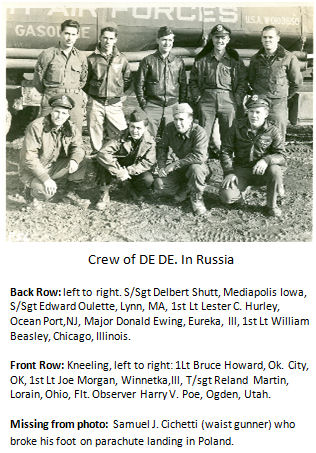 We met two Russian fighter pilots here. One had shot down a ME 109 that had followed us. There also was an FW 190 following us. He buzzed the wreckage of our ship and headed back across the front. The interrogator asked us questions pertaining to our mission, target number of planes and facts about our base and crew. We gave them as little information as we could, not thinking it advisable at the time to tell them what we did know. The Group of 4 was then taken to another house, obviously the headquarters of that area, where a General talked to them. He repeated the same questions they had heard from the Colonel and added a few of his own. He was interested in their opinion of how the war would end, so Raymond Graham Hurley obliged by giving his views on the subject. All this time there was a little Russian doctor standing in the background, a female doctor and very nice to say the least. This Doctor Kildareski kept asking if any of us were injured. She seemed interested almost eager to pre-flight one of the group and the feelings were mutual. The only one who was the least bit injured was Lt. Howard who in landing had bruised his "flux-gate compass". For some unknown reason he didn't care to have the matter checked into. That was the biggest mistake in the whole episode as far as a couple of the boys were concerned. We'll never forget that doctor though. She was really sharp. She wore a uniform much like the General's and even wore a few medals. Of course her medals stuck out at a little different angle than the General's, but we overlooked that. As an interpreter at this place, there was a Russian officer who could speak a little English. He greeted us with a "good night". We didn't know whether to stay or go and continued with "I have to ask you one question, please." His English was good at times, a little amazing, but we managed to understand him pretty well. Finally the question and answer game was over and we drove the main part of Mielic in American jeeps. We ended up after a fairly long and cold ride to a former German SS camp waiting for the others of our crew to meet us.
We met another Russian officer who could really speak English so from then on we were on guard about cracks we made. Some more questions and then a wait of a couple of hours and the Major and 6 more of the crew came in. There was a general shaking of hands, describing of experiences and complimenting on jobs. Chichetti was having a pretty bad time with his foot and had to be carried all the time. By this time it was again time to eat and all but Chichetti walked a few blocks to a dining room where we had pork and rice, dill pickles, dark bread and hot tea. Chichetti was served his meal on a cot by a Russian gal who immediately received admiring glances from at least one member of our crew, all to no avail. Our Russian friend who looked a lot like Napoleon and to be aware of the resemblance, then took us back to the room where we had met and from there to a hospital where we were put up for the night. There was a Russian truck driver that the boy nicknamed "Herman", who stuck with us all the time. He was quite a character. He did everything but was our backs for us. It was "Herman" who drove us to the town of Kolbuszowa, Poland after a good night's sleep. We stopped on the way while Herman and a Russian officer who looked like one of the Smith brothers from the cough drop fame, repaired the car we were using. While they were working on the motor, we were working on some Russian soldiers and picked up quite a few souvenirs. We were finally on our way again and after an hour more driving we reached Kolbuzowa. Here we parted company with Herman and rewarded him with a parachute for his long and faithful service. In Kolbuszowa they put us up in a house which we supposed had been taken over by the Russians for us. The house was pretty nice, equipped with beds and straw mattresses, hot and cold running Polish girls and a Russian female barber. We all got a swell shave from the barber, in fact Hurley went back for three within a half hour. Captain Bessarabenko, who could speak English pretty well, took us under his wing and saw that we were well taken care of. They gave us a Russian orderly who the boys promptly named "Shorty" and put a phone in the place to give him something to do. Oulette, Martin and Shutt held an English class with "Shorty" as the pupil several times daily and he showed promising results. After the first day he answered the phone with "blow it out" and after the second day he saluted all offices with the same greeting even the Major. Oulette was taken to a corporal right after that, never could figure why. Our first meal here brought us a new character, this time a Polish mess officer. He was quite a guy and really put on the feed for us. Huge breakfast, pickles, cheese, fish, meat and an even larger lunch and dinner. Every meal we toasted Stalin, Roosevelt and Churchill with Vodka. Martin lost his voice after the second meal. This mess officer kept yelling "Tak", "Tak" all through the meal and told us a joke to explain his constant use of the word. We never did completely understand the damn thing except that is had something to do with strip tease and that much we understood. Back at the house there was a couple of cute Polish girls and Martin, Shutt and Oulette immediately began looking into the Polish question. Bessarabenko had his hands full keeping the boys away from the girls, he never did succeed entirely. They were feeding us so often and so much the Poles make us a ball to toss around out of a potato wrapped in an escape map and we also did a little wood chopping. The Major saw us playing catch and came up the remark that it was the first time he'd ever seen any of us on the ball. He must have been kidding. About this time Martin took out cross country with one little gal and was very gallantly carrying her basket to market for her. He didn't get far as old mother Bessarabenko was right on the job and stopped him before he could do any good or bad whichever the case may be. Although we liked the Russian treatment, we didn't care much for their "revolutionary latrine". It was out of this world. You had to be an accomplished artist to use it, have an eagle eye and a keen sense of balance and a cast iron stomach also helped. I believe Poe was the first of our crew to attempt it. Major Ewing heard about his bravery and awarded him an Oak Leaf Cluster on the spot. The rest of us even with the possibility of getting a cluster as a reward, kept away from the place, even the Major himself.
It was here in Kolbuszuwa that Capt. Bessarabenko pinned a medal on the Major. It was the Russian Purple Shaftski or something and was pretty sharp. It didn't take long for us all to see that the Russians were interested in rank and medals. As a result we caught the Major in the corner with a can of white paint working over his leaf. He wasn't the only one. Poe scraped the blue off his bar and Morgan immediately mailed a letter to the Squadron to forward his sharpshooter medals, 6.2 mortar and all.
Bessarabenko gave us his picture before we left and his address. We all promised to write. He insisted that we sing "Three Blind Mice" and "How Dry I Am", the two American songs he knew and each night before going to bed he told us one of his Russian bedtime stories.
We left Kolbuszowa on December 29. Bessarabenko rode in the truck with us to an airport north of Raesjow, Poland and there we parted company. Here we met a few other boys, all victims of ack ack sharpshooters. They had been waiting for the C-47 to pick them up and take them to Poltava, the American field in Russia. They put us all together in an underground barracks, sort of a semi-upholstered gopher hole, really sharp. The weather was bad and the field was closed. We were pretty anxious to get on to Poltava but couldn't do anything about it for a couple of days. While we were there, the un-holy three, Shutt, Martin and Oulette picked up another comrade. This one they nicknamed "Oswald" and he was all out for us. He stole some general's car and rode the boys all over the country. He rode us to the mess hall, fixed us up with a private dining room and was working on a few more luxuries but couldn't quite make it. Failing in his last attempt, the boys broke him to a comrade 3rd class. Morgan had a little trouble trying to out drink a couple of Russians and almost died in the attempt. He moaned and groaned in a car dugout until we finally took him out by popular request and dumped him into the nearest snow bank. After 2 hours on ice he was almost as good as new.
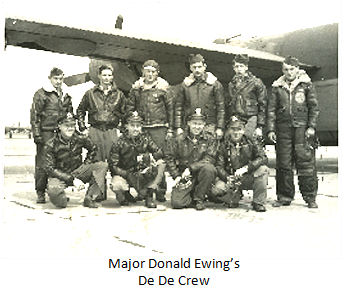 A ship from Poltava finally came in, but could only take a few of the 30 men there. They headed for Lublin, Poland to pick up some wounded airmen and couldn't take us all. They wanted to be fair about deciding who to take with them so Major Ewing with his two headed Ruble in his pocket suggested a chance. A few hours later we were on our way to Lublin.
Our C-47 landed in Lublin the same day, December 31st, after about a four hour hop. We got the usual treatment that we had been getting from all the places we had stopped so far, the usual questions and all. New Years' Eve is a big night to the Russians, so that night we saw their display of anti-aircraft and fireworks celebrating the new year. The whole sky was lit up. A little later that evening practically the whole crew was also lit up in a little display of fireworks of their own. I had quite a brawl with our crew out drinking the Russians and with their own vodka.
On New Year's day we took off for Poltava the only American base left in Russia. Everyone was little air sick after a rough trip, these Russians can't navigate above 3000 feet seems like. The trip was more or less just a long distance buzz job. We arrived in Poltava, got clean clothes, showers and shaves which we all needed pretty bad. We had all been a little constipated ever since looking at the Russian latrine. But a dash of dynamite and exlax and everything fixed us up okay.
Our stay at Poltava was really swell, at least we all enjoyed it. The 32nd Bomb Squadron sort of took over, especially in regards to the liquid refreshment department. But we all figured we had cause to elaborate and celebrate as we did every night we were there. We really got plenty of attention while we were there too, in fact every night the C.O. came to see us at about midnight to very nicely ask us to shut the hell up. They were happy to see us when we came there but I've got a sneaking suspicion they were even happier to see us go. Reluctantly they bid us goodbye on January 4th and away we went, this time heading for Teheran, Iran. That was really the spot, a beautiful field, sort of a summer resort with soldiers. It was really great. They had a bevy of beautiful polish refugees working all over the place, in the bar and in the mess hall. Hurley and a few of the boys tried dating every one they saw using all the Polish they had picked up on the trip which amounted to Yaksimach (how are you?), dobja (good), Jenkuyou (thank you) and also doma spots (the translation of which is pretty hard to explain). It was amazing how many girls refused even with our fluent display of their language. A few of the boys did finally latch on to a couple and Hurley was so impressed with his choice that he wanted to take them back with him. Major Ewing said it wasn't the proper thing to do and he wouldn't allow it and besides the inspectors found her hiding in one our barracks bags when we got on the plane.
The next stop on our cooks tour was Palestine but we only stayed there long enough to cheat a little Arab boy out of a mess of oranges and then went to Cairo. Cairo is a pretty nice place but we really got terrible food while we were there. We all got a big kick out of some corporal who mistook the Major's leaf for a gravy spot on his collar or something and proceeded to give him a hard time. After a short thousand word lecture by the Major the Corporal was a little more rank conscious, in fact he saluted the next private he saw.
We stayed in Cairo a few days, drank some very expensive orange pop and then they finally forced us on a plane and back to sunny Italy we went. We landed in Bari and then back to Foggia, back to combat and if that isn't the saddest story you ever heard I'll miss my guess. All in all we had a fairly rough time and it sort of bothered some of the boys, but it didn't bother me.
 Return.
 .
.